Key Takeaways
- A cracked tooth won’t heal on its own, and repeated chewing forces can push some cracks deeper over time.
- Waiting can narrow your treatment options, though how fast and how far a crack moves varies by type and location.
- An early dental assessment shows what’s actually going on and whether monitoring, a restoration, or something else makes sense.
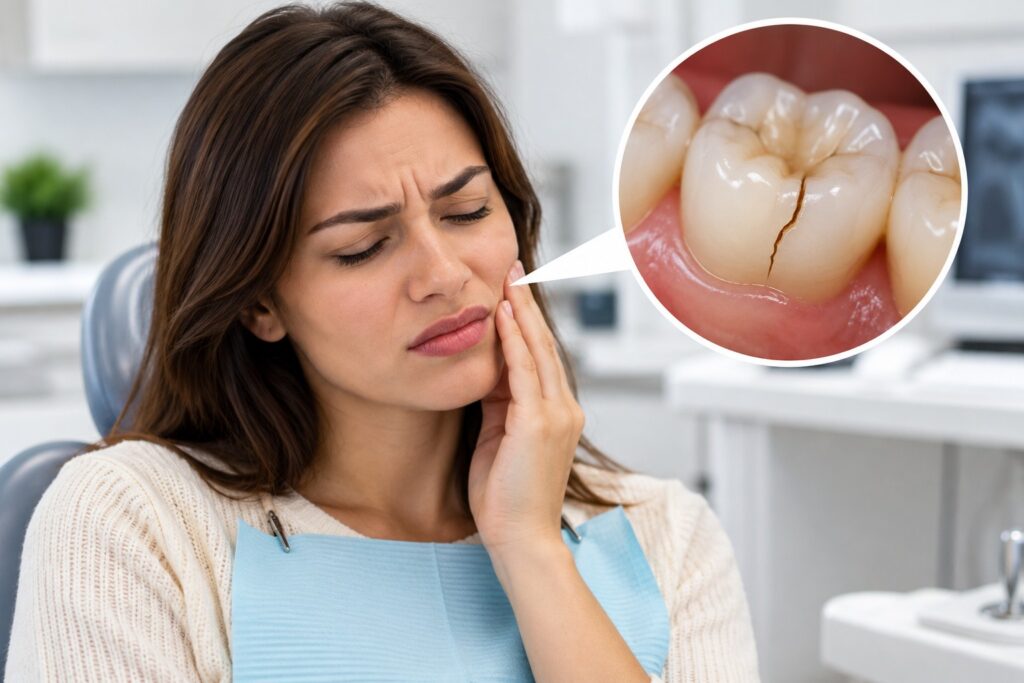
Your tooth twinges when you bite into a almond, then goes quiet for a week, and you tell yourself it’s nothing. I get it. An untreated cracked tooth rarely screams for attention, which is exactly why so many people let it sit for months. So what happens if you ignore a cracked tooth? Sometimes very little, for a while. Other times the crack travels, the inner tissue gets irritated, and a tooth that could have been repaired ends up needing far more. Mild pain tells you almost nothing about how deep the damage runs. Below, I’ll walk through how cracks progress, which signs matter, what treatment looks like, and why a dental exam beats guessing.
The Consequences of Ignoring a Cracked Tooth
Question: What does ignoring a cracked tooth actually do?
Answer: Ignoring it can let the cracked tooth gets worse, leading to more pain, trouble in the tooth’s inner tissues, infection, or eventually loss of the tooth. Not every crack moves at the same speed, though, and treatment depends on where the crack sits and how severe it is. Since symptoms can’t reveal how deep a crack goes, a dentist should assess it instead of you judging by pain level.
What can happen if you leave a cracked tooth untreated?
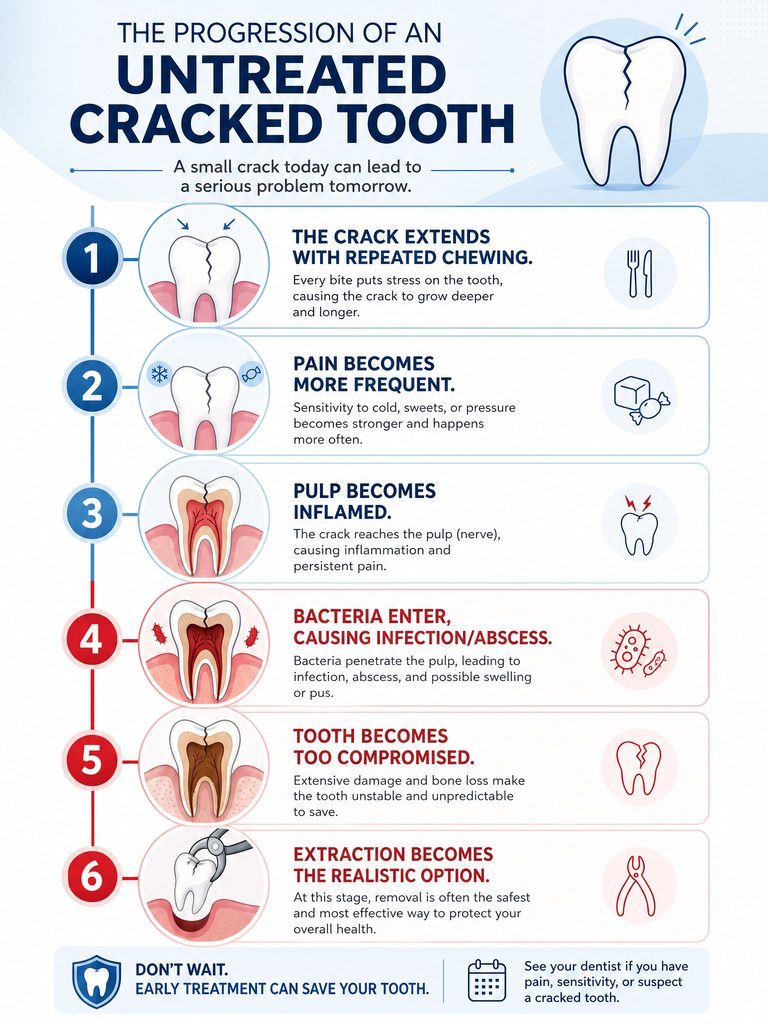
Picture a hairline in a windshield. Every bump on the highway tests it. Your molars take far heavier hits, thousands of chews a day, and cyclic chewing loads lower the elastic limit of dentin, which is the engineering way of saying the tooth gets tired. That’s how a tooth crack spreading becomes a real possibility.
None of this is a fixed script. Think of it as a menu of possible developments, in roughly this order:
- The crack extends with repeated chewing.
- Pain becomes more frequent, maybe triggered by cold, sweets, or biting.
- The pulp, the soft tissue holding the nerves and blood vessels, becomes inflamed or damaged.
- Bacteria enter through the crack and an infection or abscess develops.
- The tooth becomes too compromised to restore predictably.
- Extraction becomes the realistic option.
Some cracks stop at step one and stay there for years. Others race through. Nobody can promise which kind you have without looking.
Why does a cracked tooth seem fine for a while?

Because teeth are good at hiding things. The crack doesn’t announce itself, it just waits for the right angle of bite.
Pain that comes and goes doesn’t mean the crack healed
A cracked tooth often hurts only when pressure lands a certain way. Chew on the other side for a few days and the sharp zing disappears. Relief like that isn’t repair. You just removed the trigger.
Bone knits back together. Tooth structure doesn’t. Enamel and dentin have no meaningful way to rebuild a split, so a cracked tooth really cannot heal on its own, even when the symptoms fade. In one retrospective study of 561 cracked teeth, progression to pulpitis clustered in the first month and again between three and six months after symptoms began. Quiet stretches can be misleading.
You can’t judge the depth by looking
Plenty of fine lines in enamel are harmless. Others, invisible to you and me, run down toward the root. A mirror and a flashlight won’t sort one from the other, and neither will a phone photo.
Dentists lean on a few tools: visual exam under magnification, a bite test on individual cusps, gum probing, sometimes imaging. X-rays alone can miss a crack, which surprises people. That’s why diagnosis can take more than one look.
Does every cracked tooth get worse?
No. I’d rather say that plainly than scare you.
A craze line in the enamel is a different animal from a crack that reaches the dentin, and both differ from a split that runs below the gum line. Location, depth, direction, and how much healthy tooth remains all matter. Molars take the brunt of it; one analysis found molars made up roughly 79% of cracked tooth cases, which fits with how hard they work.
A crack that stays on the chewing surface may just get watched. A crack that extends below the gum line or into the root is the tough one. Those are harder to seal, harder to keep clean, and more likely to end in a tooth that cannot be saved. There’s no universal countdown, so anyone quoting you a number of weeks is guessing.
How does waiting change your treatment options and costs?
I’ll be blunt about my opinion here: “I’ll just wait and see” is a lousy gamble. The crack won’t mend, and leaving it can turn a tooth that might have been kept into one that has to come out. Then you’re staring at an extraction and possibly an implant or bridge. Saving money by waiting can be a pretty expensive way to save money.
Fair caveat, though. Waiting doesn’t always raise the bill, and an early visit doesn’t always dodge a root canal. Cost hangs on the diagnosis, the tooth involved, your insurance, and the practice’s fees. What I can say is that dentists typically have more choices when more tooth is left. In a large U.S. practice-based network study following 2,858 cracked back teeth, about 14% of restorative treatments failed within three years, which shows that even treated cracks need follow-up.
| Possible finding | Treatment that may be discussed | What determines the decision |
|---|---|---|
| Superficial enamel line | Monitoring or routine care | Whether the line is truly superficial and whether symptoms are present |
| Crack affecting tooth structure | A protective restoration, sometimes a crown | Crack location, extent, and remaining tooth structure |
| Crack with pulp involvement | Root canal treatment plus restoration may be considered | Pulp health and whether the tooth can be restored |
| Tooth cannot be restored predictably | Extraction may be recommended | Extent and location of the crack and overall prognosis |
This is general information, not a treatment plan or price quote.
Once the pulp is hurt, an endodontist or general dentist may talk about root canal therapy plus a crown. When it’s beyond saving, the conversation shifts to extraction and replacing the tooth. Ask your dentist what your likely options are, what each one costs with your coverage, and what could happen if you postpone. Those three questions save a lot of confusion.
What happens when infection and bone loss enter the picture?
This is the part nobody wants to hear, and it’s the reason I’d rather you not wait.
Research on unrestored non-vital teeth has shown that microcracks on the chewing surface can reach the pulp, leading to necrosis and bone breakdown around the root. Once bacteria sit in dead tissue, you can end up with a tooth abscess, swelling, a pimple-like bump on the gum, and a bad taste. Delayed diagnosis has also been tied to deep periodontal pockets and abscess formation beside the tooth.
Bone loss changes the math too. One long-term study found that more localized bone loss raised the odds of eventual extraction to 10.63. In compromised cracked teeth, survival in another cohort slid to about 66% at ten years and 55% at fifteen, with probing depth flagged as a major hazard. Deep pockets beside a crack aren’t a good sign.
Warning signs that mean you shouldn’t keep waiting

Plenty of people hold out for severe pain. Please don’t. Severe is late. Look for these instead:
- New or worsening pain when you bite or release
- Lingering sensitivity to cold or hot after the food is gone
- Pain with no obvious trigger
- A visible crack, a broken piece, or a loose filling or crown
- Gum swelling, a bump near the tooth, or a bad taste
Any of those, call a dentist promptly. Significant pain or swelling means seeking urgent dental advice. Trouble breathing or swallowing, or swelling that’s spreading fast across your face or neck, is a medical emergency, so head to the ER.
What should you do if you think you have a cracked tooth?
Book the exam. That’s the core of it. Meanwhile, a few steps can keep the tooth calmer:
- Skip hard, crunchy, and sticky foods on that side until it’s checked.
- Choose softer foods if chewing hurts.
- Brush gently and keep up normal oral hygiene.
- Don’t glue, file, or “fix” it yourself.
- If a fragment breaks off, store it in a clean container and bring it along.
None of this repairs a structural crack. It only lowers irritation while you wait for your appointment. If you’re near Dental Care 4 U in South Holland, Illinois, call and ask about an assessment. Don’t assume a same-day slot, though; just ask what’s available.
Waiting is a decision, not a diagnosis
A cracked tooth might stay stable for years or might quietly get worse; the specific crack decides. Pain level can’t tell you which. An exam can clarify the condition, the options, and the likely costs before you commit to anything. So ask your dentist what monitoring risks versus what treating now looks like, and then pick with real information instead of a hunch.
Frequently Asked Questions
Can a cracked tooth heal itself?
No. A structural crack doesn’t fuse back together like a broken bone. Symptoms may settle, but that isn’t healing. A dentist can assess the damage and advise whether monitoring or treatment makes more sense for that tooth.
How quickly can a cracked tooth get worse?
There’s no dependable timeline. Some cracks stay stable, while others worsen with chewing forces or other stress. Since speed can’t be predicted from symptoms alone, arrange an assessment instead of waiting for a particular deadline to pass.
Can I ignore a cracked tooth if it doesn’t hurt?
What happens if you ignore a cracked tooth? A lack of pain doesn’t guarantee a crack is harmless, not safely, since some cause few symptoms early on. If you suspect a crack or notice visible damage, book an exam so you know what it means for that tooth.
Will every cracked tooth need a crown?
No. It depends on the type, location, and extent of the crack and how much healthy tooth remains. Surface lines may only need monitoring, while structural cracks may call for a protective restoration or other treatment.
When is a cracked tooth an emergency?
Call a dentist promptly for worsening pain, a broken tooth, or significant swelling. Trouble breathing or swallowing, or swelling that spreads quickly, needs emergency medical care. Don’t hold out for a routine appointment if those symptoms show up.
Read More Articles
Dental Crowns in South Holland, IL: Types, Costs, Timeline and What to Expect
Same-Day Crowns in South Holland: One Visit, No Temporary Crown
What a Dental Crown Costs in South Holland: 2026 Price Ranges by Material
Broken or Lost Crown? Emergency Crown Repair in South Holland
Replacing an Old or Failing Crown: When It’s Time and What It Costs
Getting a Crown at Dental Care 4U: What Happens at Each Visit
Crown or Extraction? How We Decide Whether a Tooth Can Still Be Saved
Will Your Plan Cover a Crown? How to Check Before You Book
Paying for a Crown Without Dental Insurance in South Holland
Front Tooth Crowns in South Holland: Getting the Colour and Shape Right
Crowns for Children and Teens: Stainless Steel and Tooth-Coloured Options
Porcelain vs Zirconia vs Metal Crowns: Which One Actually Lasts
Same-Day vs Lab-Made Crowns: What You Trade for the Speed
Filling, Onlay or Crown: How Much Damage Changes the Fix
Crown or Veneer: Which One Your Front Tooth Actually Needs
Crown or Implant: When to Save the Tooth and When to Replace It
How Long a Crown Takes, Step by Step
Do You Need a Root Canal Before a Crown?
How Long Crowns Last and What Shortens Their Life
Does Getting a Crown Hurt? What the Numbing and Recovery Actually Feel Like
Choosing a Dentist for Crown Work in South Holland: What to Ask First
Why Your Tooth Hurts When You Bite Down
Cracked Tooth Syndrome: The Pain That Comes and Goes
What a Large Old Filling Does to a Tooth Over Time
Why Teeth Break: Grinding, Age and the Foods That Do It
Crown, Cap, Onlay: What the Words Your Dentist Used Actually Mean
Signs a Tooth Needs More Than a Filling
Chipped a Tooth? What to Do in the First 24 Hours