Everyone assumes “same-day” is code for “rushed.” I get why. If a mechanic tells you the brake job takes ten minutes, you start wondering what corner just got cut. Dental crowns get the same suspicious side-eye. But here’s the actual answer, and it’s not the one people expect: a same-day crown and a lab-made crown aren’t a fast version and a slow version of the same product. They’re two different manufacturing philosophies, and which one serves you better depends entirely on the tooth sitting in your mouth right now, not on some universal ranking of quality.
I’ve spent enough time poking around dental forums and clinical literature to notice a pattern. People want a simple verdict. Faster is worse, or faster is fine, pick one. Reality refuses to cooperate. A same-day crown milled from a solid block of lithium disilicate or zirconia, placed by a dentist who’s done a thousand of them, can outperform a poorly executed lab crown from a rushed impression.
And a beautifully hand-layered porcelain restoration from a skilled ceramist can outlast a same-day crown slapped on a tooth that was never a good candidate for chairside fabrication in the first place. Craftsmanship and case selection matter more than which building the crown was born in.
Key Takeaways
- Same day dental crowns can restore a tooth in one appointment, reducing the need for a temporary crown and a second visit.
- CEREC vs lab crown is not simply a choice between better and worse. Same-day crowns offer speed and convenience, while lab-made crowns provide more material choices and time for detailed customization.
- One visit vs two visit crown depends on the tooth, remaining structure, bite, material needed, and complexity of the case. Not every tooth is a good candidate for same-day treatment.
Are Same-Day Crowns as Good as Lab-Made Crowns?
Question: Are same day crowns as good as lab-made crowns?
Answer: Yes, a properly planned same-day crown can be just as effective as a lab-made crown in the right case. The quality depends on the material used, treatment planning, digital scanning, bite registration, fitting, and cementation—not simply whether the crown was made in a dental office or laboratory. Same-day crowns offer the convenience of completing treatment in one visit, while lab-made crowns may be better for complex cases or teeth that require greater customization and a wider range of materials.
The best choice in a CEREC vs lab crown comparison depends on your specific tooth and treatment needs rather than speed alone.
Same-Day vs. Lab-Made Crowns at a Glance
Before diving into the mechanics, it helps to see the two workflows side by side. This isn’t meant to crown a winner (pun very much intended). It’s meant to show you where the actual trade-offs live.
| Factor | Same-Day Crown | Lab-Made Crown |
|---|---|---|
| Number of visits | Often just one | Usually two or more, spaced over two to three weeks |
| Manufacturing | Designed and milled in the dental office | Fabricated by an outside dental laboratory |
| Temporary crown | Frequently skipped | Commonly worn while waiting |
| Material options | Typically limited to milling-compatible ceramic blocks | Broader range, including porcelain-fused-to-metal and layered porcelain |
| Customization | Digital design, applied quickly | Manual layering, more time for nuance |
| Best suited for | Molars and premolars with straightforward preps | Front teeth, complex bites, or cases needing specific materials |
Notice that “durability” isn’t a clean row with an obvious winner. That’s intentional. It depends too heavily on the specific ceramic used and the skill behind the bonding.
How a Same-Day Crown Actually Comes Together
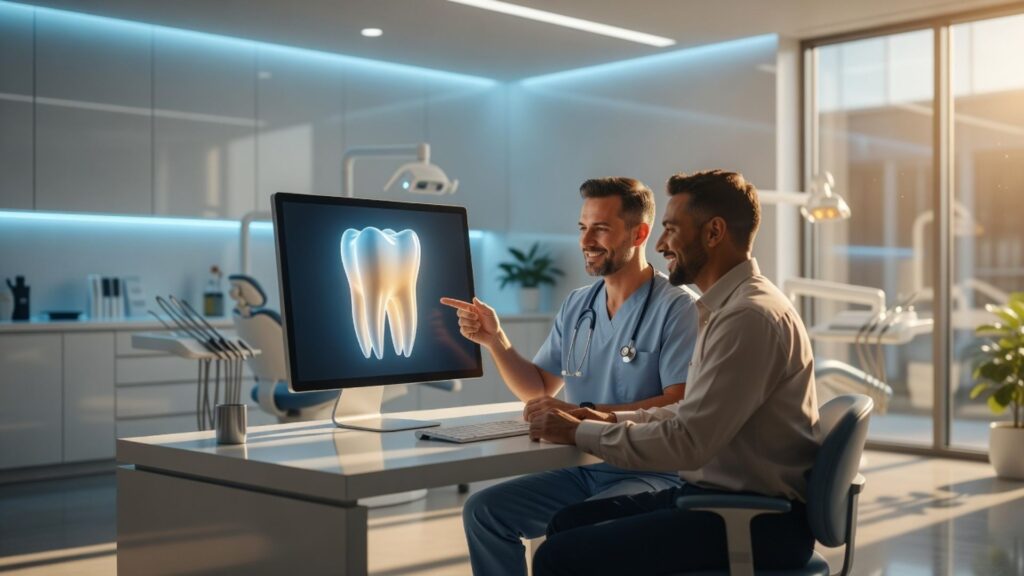
The process is less magic and more industrial design, honestly. A dentist examines the tooth, preps it (shaving down the damaged or decayed structure), then instead of squishing a tray of goopy impression material into your mouth, they run a digital scanner over the area. That scan gets turned into a 3D model on a screen, right there in the room.
The dentist tweaks the shape, the contact points, the bite, all using CAD software. Once it looks right, the file gets sent to a small in-office milling unit that carves the crown out of a solid ceramic block in about fifteen to twenty minutes. Then comes fitting, adjusting, polishing, and cementing. Start to finish, most appointments run somewhere between one and two hours.
CEREC gets thrown around like it’s a synonym for “same-day crown,” and that’s a little sloppy. CEREC is a specific brand of chairside CAD/CAM system, one of several on the market that let a practice design and mill restorations without shipping anything to an outside lab. Not every office with same-day capability uses CEREC specifically, and having the technology doesn’t mean every tooth qualifies for it.
A cracked molar with a straightforward margin above the gumline? Probably fine. A tooth that needs a crown built up from almost nothing, or one buried deep with a complicated bite relationship? That’s a harder sell for a milling machine.
The Traditional Lab Workflow, and Why It Still Matters
The lab-made process starts identically: exam, prep, scan or impression. From there it splits. Instead of milling in-house, the digital file (or, less commonly now, a physical mold) gets shipped to a dental laboratory where a technician designs and fabricates the restoration by hand or with lab-grade equipment.
This takes days, sometimes two to three weeks, so you wear a temporary crown made of acrylic resin in the meantime. It’s not glamorous. Temporaries can feel loose, look chalky, and occasionally pop off at the worst moment (usually while eating something you shouldn’t have).
But that waiting period buys something real: a technician with more time and a wider material palette. Porcelain-fused-to-metal crowns, layered ceramics with subtle color gradients, custom shade matching for a front tooth sitting next to its natural neighbors, these are places where a lab’s manual craftsmanship still has an edge over a machine pulling a single-shade block off a shelf.
If your case involves heavy grinding, a compromised bite, or a tooth that needs serious structural rebuilding, a lab-fabricated crown, sometimes cast in gold alloy, remains the more forgiving option.
Are Same-Day Crowns Actually as Good?
There’s no clean yes or no here, and honestly, anyone who gives you one is oversimplifying. What the independent research actually shows is more nuanced. Long-term data on chairside CAD/CAM restorations points to roughly a 95 percent survival rate at the five to ten year mark, with success rates dropping to somewhere between 84 and 90 percent by year fifteen. That’s a solid track record. But it depends almost entirely on material choice. High-strength ceramic blocks hold up beautifully. Cheaper resin-ceramic hybrids fail at noticeably higher rates over time. The chairside process itself isn’t the variable that determines longevity. The material milled and the hands doing the fitting are.
Quality actually hinges on a chain of small decisions: correct treatment planning, a clean digital scan (garbage in, garbage out, as with any digital workflow), accurate bite registration, proper cementation, and honestly, how cooperative the patient’s mouth is being that day. I’ve heard the frustration firsthand from someone who watched a friend get a same-day crown squeezed in between work trips.
On paper, it was perfect. One visit, done, back to the airport. Except the bite felt slightly off starting day one. Back for an adjustment. It worked out fine eventually, but that “I saved so much time” victory got a little dented by the follow-up visit. Same-day workflows compress a whole chain of clinical decisions into one sitting, and if any single link in that chain wobbles, you feel it immediately instead of catching it before the final crown is even cemented.
What You’re Actually Trading for Speed
Convenience is real and it matters. Fewer appointments means less time off work, no juggling childcare twice, no second round-trip commute for something that could’ve been handled once. For a lot of working adults, that alone justifies the choice.
What you might give up:
- Material breadth — same-day systems pull from a narrower set of milling-compatible ceramic blocks, while a lab can pull from metal alloys, layered porcelains, and hybrid composites.
- Aesthetic subtlety — front teeth with visible translucency and color gradients are still where a human ceramist’s manual layering tends to outshine a machine milling a monochrome block.
- Time for course-correction — a lab workflow gives the dentist a second look at the fit before final cementation; a same-day crown gets adjusted and seated in the same visit it’s designed.
None of this means same-day is inferior. It means it’s a different set of trade-offs, and the right one depends on where the crown is going and what that tooth needs to survive daily chewing forces.
Cost Isn’t as Simple as “Faster Equals Cheaper”
People assume skipping the lab cuts the price. Not necessarily. Total cost depends on material, the complexity of the prep, whether a core buildup is needed, and how your insurance plan classifies the restoration. Ask for an itemized estimate that includes the exam, any temporary crown, fabrication, and placement, rather than comparing crown types on sticker price alone.
A Few Quick Answers
Will I need a temporary crown? Often not with a qualifying same-day case, but nearly always with a lab-made restoration, since something has to protect the prepped tooth for those two to three weeks.
Is a same-day crown permanent? It’s intended as a definitive restoration, not a placeholder, though no crown lasts forever regardless of how it was made.
Can every tooth get one? No. Candidacy depends on the tooth’s location, the remaining structure, your bite, and the equipment the office actually has.
If you’re staring down a crown recommendation right now, the smartest move isn’t picking a workflow off a marketing brochure. Ask your dentist why they’re recommending same-day or lab-made for your specific tooth, what material they’d use, and what the total cost looks like before insurance. That conversation tells you more than any comparison chart ever will.