Key Takeaways
- Crowns, caps, and onlays serve different purposes. A crown covers the entire visible part of a tooth, while an onlay restores a damaged section without covering the whole tooth.
- A dental cap is another name for a crown. Dentists often use these terms interchangeably, so hearing either one generally means the same treatment.
- The right option depends on your tooth’s condition. Your dentist will recommend a crown or onlay based on the extent of the damage, the remaining healthy tooth structure, and your overall oral health.
You nod along while the dentist talks, then walk out to the parking lot thinking, wait, crown? Cap? Did she say onlay? It happens to nearly everybody, and no, you were not supposed to know.
So, what is a dental crown? It’s a custom-made, tooth-shaped cover that fits over the visible part of a damaged tooth, above the gumline, to restore its shape, strength, and function. “Cap” is the everyday nickname for the same thing. An onlay is a related but different restoration that covers less of the tooth. That’s dental crown explained in three sentences. The rest of this is about using those words to ask better questions.
Understanding the Difference Between a Crown, Cap, and Onlay
Question: What is the difference between a crown, cap, and onlay?
Answer: A dental crown, also called a cap, covers the entire visible portion of a tooth to restore its strength, shape, and function. An onlay covers only the damaged or weakened parts of a tooth, including one or more cusps, while preserving more of the healthy tooth structure. Your dentist will recommend the most suitable option based on the extent of the damage and the amount of healthy tooth remaining.
What Is a Dental Crown, Really?
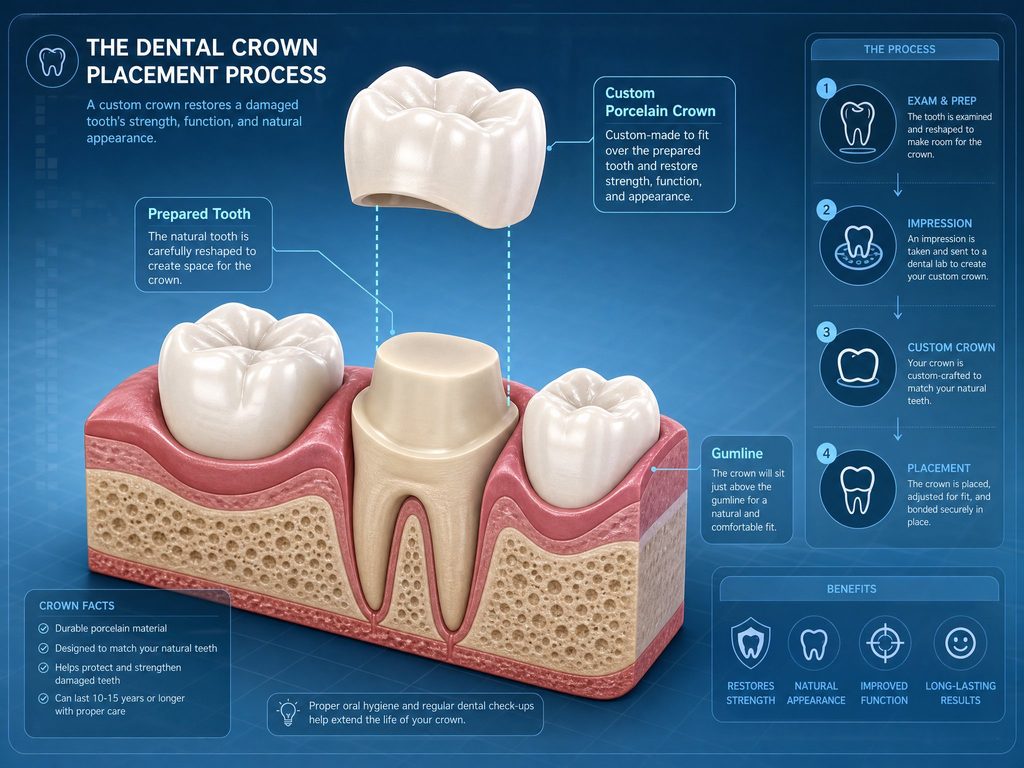
Picture a thimble on your finger. Now picture it made of porcelain or metal, shaped like a molar, and cemented over a tooth that’s been cracked, drilled out, or worn down. That’s the crown.
My own opinion, and I’ll stand by it: a crown is a cap, not some magical tooth upgrade. It doesn’t give you your original tooth back. Your dentist (or a prosthodontist, the specialist who focuses on restoring and replacing teeth) shaves away part of the enamel so the cover has room to sit, and what ends up in your mouth is a well-fitted shell over what’s left of the real thing. Useful? Absolutely. Glamorous? Not so much.
When might a dentist bring one up? The Cleveland Clinic’s overview of crowns lists the usual suspects, and in practice they look like this:
- A tooth with significant structural damage or heavy decay
- A tooth carrying a large existing filling that’s running out of walls to hold on to
- A fractured or weakened tooth that could split further
- A tooth that needs protection after a root canal
Notice the word “might.” None of these is an automatic sentence. A cracked tooth doesn’t always need a crown, and neither does every root-treated one. A crown is a restoration for one individual tooth, bonded in place, which makes it nothing like a removable denture.
Is a Dental Cap the Same as a Crown?
Mostly, yes. Tooth cap meaning? Same thing, older slang.
Your aunt says “cap.” Your 2009 pamphlet says “cap.” Your dentist writes “crown” on the treatment plan. Nobody’s wrong. In ordinary dental conversation, a tooth cap is a dental crown, and “cap vs crown” isn’t a real fork in the road. It’s two names stuck to one object, a bit like “soda” and “pop.”
The catch is paperwork. If a document says one thing and a friend says another, or if the wording on your estimate looks off, ask the office to confirm exactly what’s being planned. That takes thirty seconds and saves a lot of confusion.
The difference between a dental cap vs crown is mainly in the terminology, not the treatment itself. A dental cap is simply another name for a dental crown, and both refer to a restoration that covers the entire visible portion of a tooth to protect it, restore its shape, and improve its function. Dentists may use either term when discussing treatment for a damaged, weakened, or heavily filled tooth. If your dentist mentions a cap or a crown, they are generally referring to the same procedure.
What Is an Onlay?
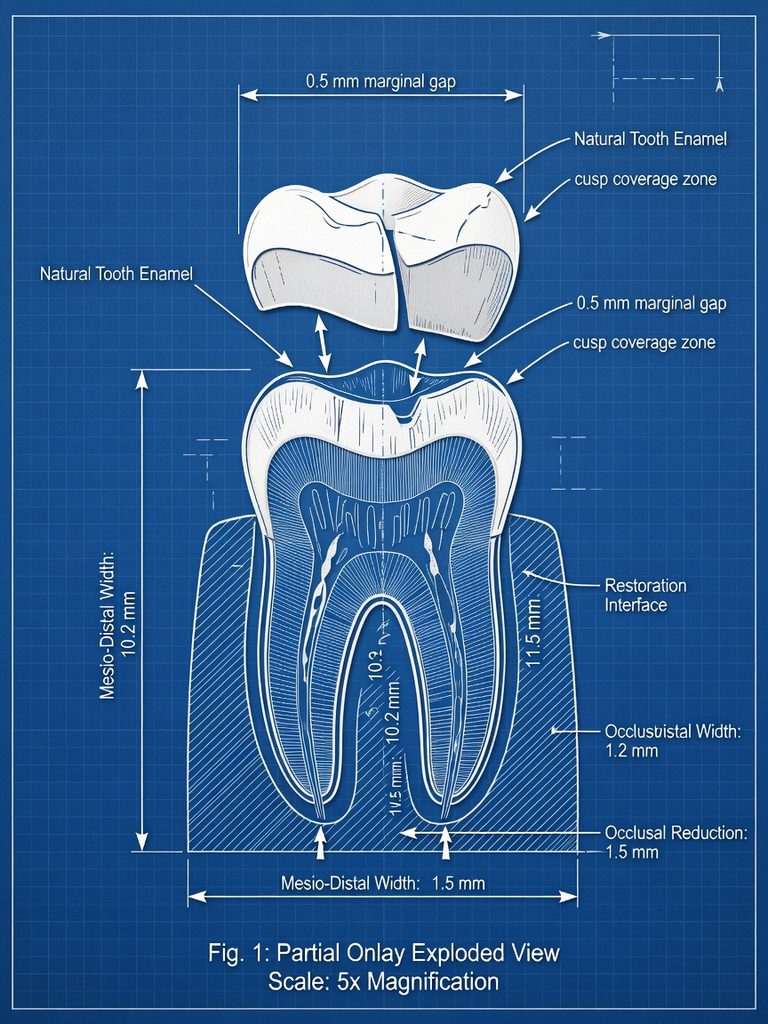
Here’s where the vocabulary actually matters.
An onlay is a partial-coverage restoration. It replaces damaged tooth structure and covers one or more cusps, which are the raised points on a tooth’s chewing surface. Think of it as bigger than a filling and smaller than a full crown. Some dentists use “overlay” as a near-synonym, so don’t panic if you hear that word too.
Why would anyone choose it? In suitable cases, an onlay may preserve more of the natural tooth, since less gets trimmed away. Notice the qualifier. It doesn’t mean onlays are stronger, cheaper, or longer-lasting across the board, because they aren’t. Whether one fits depends on where the damage sits, how much healthy structure remains, and what the tooth has to do all day. A molar that grinds through steak is a different job than a front tooth.
Crown vs Cap vs Onlay: The Short Version
| Term | What it means | Coverage | Worth remembering |
|---|---|---|---|
| Crown | A restoration covering the visible portion of a tooth | Wraps the tooth’s visible surface on all sides | Often called a cap |
| Cap | Informal name for a crown | Usually the same as a crown | Ask for clarification if a document uses it differently |
| Onlay | A partial-coverage restoration | Covers damaged areas and one or more cusps, not necessarily the whole tooth | May preserve more natural tooth in suitable cases |
| Filling | Material used to repair a damaged or decayed area | Usually a more limited area | Suitable when enough healthy structure remains |
Don’t pick a favorite from this table based on the name. These options aren’t interchangeable, and your dentist, not a menu, decides which one is clinically suitable.
Why Would a Dentist Recommend One Over Another?
Not because of price tiers. A filling, an onlay, and a crown aren’t good, better, best. They’re answers to different questions.
The dentist weighs how much healthy tooth remains, how big the damaged area is and where it sits, whether a cusp is cracked or weakened, how deep the decay runs, and how hard that tooth gets used when you bite. Your overall oral health and treatment history count too. The Cleveland Clinic’s page on dental restorations walks through how reshaping the tooth fits into all this, and that reshaping is the very reason the amount of leftover tooth drives the decision.
So the useful question isn’t “What is this treatment called?” It’s “What does my tooth need, and why?” Dentists tend to like that question. It tells them you’re paying attention.
Curious how dentists actually weigh a filling, onlay, or crown against each other? That comparison deserves its own read, so look for a guide on exactly that once you’ve got the vocabulary down.
Five Questions to Take to Your Next Appointment

Screenshot these. Seriously.
- Can you show me the area of the tooth that needs repair?
- Why are you recommending a crown or onlay instead of a filling?
- What other options are suitable for this tooth?
- How much healthy tooth structure will the restoration cover or preserve?
- What could happen if I wait, and how soon do you recommend treatment?
Got a cost worry? Add one more: can I get a written estimate that lists the recommended restoration and any extra procedures separately? A root canal, a core buildup, and the crown itself can show up as separate line items, and seeing them apart keeps surprises small. If insurance is involved, the ADA’s guidance on crown claims shows what payers typically expect.
None of this is about challenging your dentist. You’re making sure the recommendation makes sense to you before you say yes.
A Quick Word on What Happens Next
Since you’ll hear it eventually: a typical crown takes two visits. The tooth gets prepped, meaning enamel is removed and an impression or digital scan is taken, then a dental technician builds the custom crown while you wear a temporary one. Later, the final crown replaces the temporary. MedicalResearch.com’s walkthrough of placement covers the reasons and steps in more detail.
Some people feel mild sensitivity or bite discomfort afterward. Usually it settles. If your bite feels high or the ache hangs around, call the office. And if the tooth already had a root canal, the Mayo Clinic’s explanation of root canal treatment explains why a crown often follows, since a tooth that’s lost its pulp can turn brittle.
Where to Learn More About Crown Materials
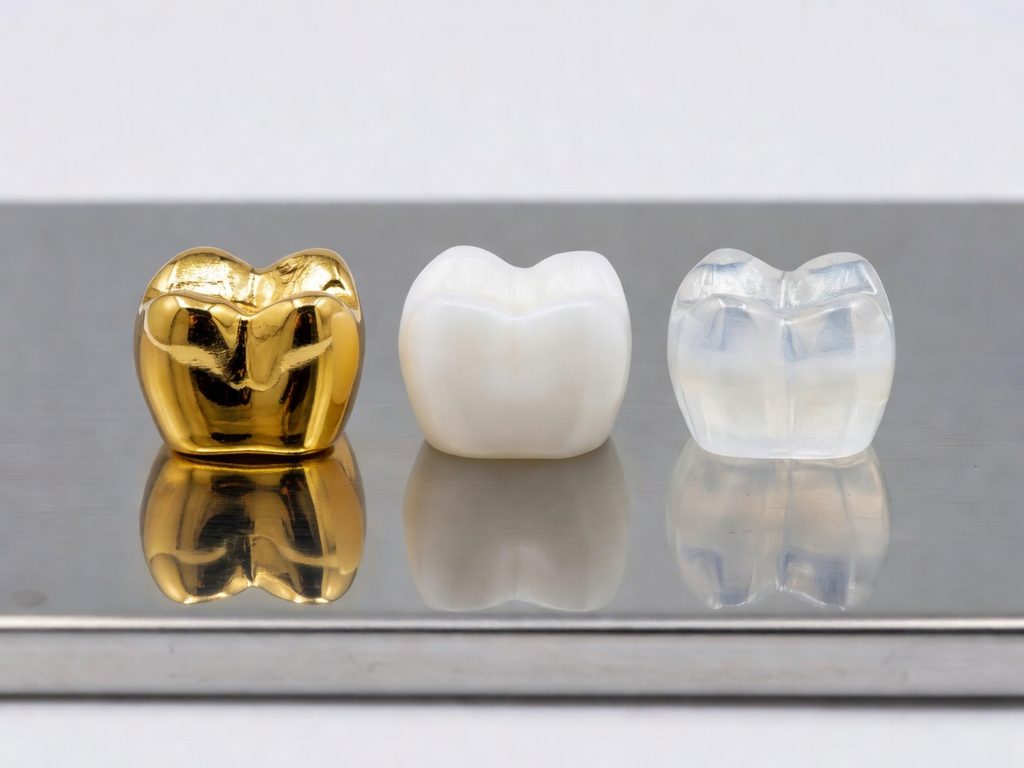
Material is a separate question from “crown or onlay?” Porcelain, ceramic, pressed ceramic, zirconia, gold, other metal, and PFM (porcelain-fused-to-metal) all have tradeoffs in looks, wear, and chip risk. The ADA’s reference on indirect restorative materials lays out strength and indications side by side, and a JADA clinical evaluation of zirconia crowns shows complication rates vary by tooth position, with back teeth taking more risk than front ones.
Lifespan? Rough numbers run five to fifteen years, sometimes much longer with good care, and Colgate’s guidance on loose restorations is blunt about chewing ice and hard candy. Don’t.
Now the opinion I promised. The “premium material” arms race is overrated. People online, including threads comparing crown types and prices in India, trade notes on which fancy ceramic costs what, and paying extra only because a material sounds impressive isn’t automatically smart. Match the material to the tooth’s job. A back molar and a front tooth have different needs. Treat the crown as a practical fix when the tooth needs one, not a luxury makeover.
Ready to dig in? Next up, compare porcelain, zirconia, and metal crowns and see what each option is actually designed to do.
Understanding Dental Terms in South Holland, IL
If you leave any appointment still fuzzy, ask again. A good practice will explain things in everyday language without making you feel small. At Dental Care 4 U, serving patients looking for a dentist in South Holland, IL, that kind of back-and-forth is part of the job. Call and ask the team to walk through your treatment plan again. Still unsure what it means? Ask your dentist to explain the options, in plain English, until it clicks.
Frequently Asked Questions
Is a cap different from a crown?
Generally no. “Cap” is the informal name for a dental crown. If your paperwork words it differently, ask the practice to confirm what’s planned.
Is an onlay the same as a crown?
No. An onlay is partial coverage, while a crown covers the visible portion of the tooth more fully. Which fits depends on your tooth.
Is an onlay better than a crown?
Neither wins automatically. Your dentist considers remaining tooth structure, the damage, how you bite, and other clinical factors.
Can I ask for a different option?
Yes. Ask about alternatives, benefits, limits, risks, and costs. Your dentist can tell you which options are clinically suitable for that tooth.
Read More Articles
Dental Crowns in South Holland, IL: Types, Costs, Timeline and What to Expect
Same-Day Crowns in South Holland: One Visit, No Temporary Crown
What a Dental Crown Costs in South Holland: 2026 Price Ranges by Material
Broken or Lost Crown? Emergency Crown Repair in South Holland
Replacing an Old or Failing Crown: When It’s Time and What It Costs
Getting a Crown at Dental Care 4U: What Happens at Each Visit
Crown or Extraction? How We Decide Whether a Tooth Can Still Be Saved
Will Your Plan Cover a Crown? How to Check Before You Book
Paying for a Crown Without Dental Insurance in South Holland
Front Tooth Crowns in South Holland: Getting the Colour and Shape Right
Crowns for Children and Teens: Stainless Steel and Tooth-Coloured Options
Porcelain vs Zirconia vs Metal Crowns: Which One Actually Lasts
Same-Day vs Lab-Made Crowns: What You Trade for the Speed
Filling, Onlay or Crown: How Much Damage Changes the Fix
Crown or Veneer: Which One Your Front Tooth Actually Needs
Crown or Implant: When to Save the Tooth and When to Replace It
How Long a Crown Takes, Step by Step
Do You Need a Root Canal Before a Crown?
How Long Crowns Last and What Shortens Their Life
Does Getting a Crown Hurt? What the Numbing and Recovery Actually Feel Like
Choosing a Dentist for Crown Work in South Holland: What to Ask First
Why Your Tooth Hurts When You Bite Down
Cracked Tooth Syndrome: The Pain That Comes and Goes
What a Large Old Filling Does to a Tooth Over Time
Why Teeth Break: Grinding, Age and the Foods That Do It
Signs a Tooth Needs More Than a Filling
Chipped a Tooth? What to Do in the First 24 Hours
Why a Crowned Tooth Can Still Get a Cavity