Why does my tooth hurt? Tooth pain can be distracting and difficult to ignore, whether you’re working, eating, or trying to sleep. While the discomfort is easy to notice, the cause isn’t always obvious. Toothaches can result from a range of issues—from cavities and cracked teeth to gum disease, infections, or tooth sensitivity—so understanding the source is the first step toward finding the right treatment.
And that’s exactly why so many people spiral into worst-case-scenario thinking the second a tooth starts aching. “Is it a root canal? Do I need it pulled? Did I wait too long?” Probably not. But the only way to actually know is to understand what tooth pain is really communicating — and what it isn’t.
Tooth pain is a symptom. Not a diagnosis. The dental pulp — the innermost layer of your tooth, packed with nerves and blood vessels — becomes inflamed or exposed, and that’s when you feel it. But what caused that inflammation? That’s the part that varies wildly. A cavity looks nothing like a cracked tooth under an X-ray, even if both make you wince when you take a sip of coffee. A sinus infection can refer pain straight into your upper molars and feel indistinguishable from decay. Same symptom, completely different story.
So before you start diagnosing yourself at 11 PM with whatever search results Google throws at you, take a breath. This guide walks through the most common reasons a tooth hurts, the signals worth paying attention to, and the point at which you should stop waiting and call a dentist.
The Most Common Causes of Tooth Pain, Explained Simply
Cavities and Tooth Decay
Cavities don’t usually announce themselves early. Enamel — the hard outer shell of your tooth — erodes slowly, often silently, as bacteria in plaque convert sugars into acids. Once that bacteria reaches the softer dentin layer underneath, things start getting uncomfortable fast. According to CDC oral health data, about 1 in 5 adults between 20 and 64 has at least one untreated cavity. That’s a staggering number of people walking around with aches they haven’t addressed yet.
The pain from a cavity tends to be triggered — by sweets, by cold drinks, by chewing — rather than constant. Until it’s not. When decay reaches the pulp, that occasional twinge becomes something a lot harder to ignore.
Tooth Sensitivity
Worn enamel and receding gums share a common consequence: exposed dentin. That softer tissue has microscopic channels that run directly toward the nerve, so temperature changes and certain foods create sharp, fleeting sensations. Research on dentin hypersensitivity suggests it affects a remarkably high percentage of the population — some estimates put it around 74%. Sensitivity toothpastes and fluoride treatments can help, but if the sensitivity is new, worsening, or paired with other symptoms, it’s worth getting checked.
Cracked or Chipped Teeth
This one is sneaky. A cracked tooth — sometimes called cracked tooth syndrome — may produce sharp pain when biting down that disappears almost immediately after you release pressure. The crack opens and closes like a tiny hinge, irritating the pulp without necessarily being visible to the naked eye. Mayo Clinic notes that trauma, teeth grinding (bruxism), or biting down on something hard can create these fractures. The discomfort tends to be inconsistent, which makes people dismiss it — usually until it progresses.
Gum Disease
Periodontal disease is a slow burn. Early-stage gingivitis causes swollen, tender, bleeding gums, but it doesn’t always hurt, which is part of why it advances undetected. As gum tissue pulls away from the teeth, roots become exposed, bone loss begins, and pain enters the picture. Loose teeth in advanced cases are a serious warning sign that treatment can’t be postponed.
Dental Infection or Abscess
An abscess is a bacterial infection that develops at the root of a tooth or in the surrounding gum tissue. It can result from untreated decay, a cracked tooth, or gum disease creating a pathway for bacteria. The Mayo Clinic describes it as producing throbbing pain, localized swelling, bad taste in the mouth, and sometimes fever. This is the scenario where waiting is genuinely risky — dental infections can spread beyond the mouth. If you suspect an abscess, prompt evaluation matters.
Teeth Grinding (Bruxism)
A lot of people grind or clench their teeth at night without realizing it. The jaw operates with enormous force, and chronic bruxism wears down enamel, creates micro-fractures, and puts sustained pressure on the pulp — all of which translates to morning soreness, jaw discomfort, and generalized tooth aching. The Cleveland Clinic points to TMD and grinding as significant contributors to tooth pain that doesn’t originate from decay at all.
Sinus Pressure and Non-Dental Causes
Upper molar roots sit remarkably close to the maxillary sinuses. When those sinuses become inflamed — from a cold, allergies, or a sinus infection — the pressure can radiate directly into your teeth. The pain feels dental, but it isn’t. Wisdom tooth pain, referred pain from sinus infections, and even trigeminal neuralgia can all masquerade as toothaches. This is precisely why a proper exam matters: treating the wrong thing doesn’t fix anything.
Here’s a quick-reference look at how symptoms might point toward different causes:
| Symptom | Possible Cause(s) |
| Sharp pain when biting down | Cracked tooth, cavity, loose filling |
| Sensitivity to hot or cold | Worn enamel, receding gums, early cavity |
| Throbbing, persistent ache | Abscess, deep decay, pulp inflammation |
| Morning jaw/tooth soreness | Bruxism, teeth clenching |
| Pain in upper back teeth + congestion | Sinus infection, referred pain |
| Tender, bleeding gums | Gum disease, gingivitis |
Symptoms and Warning Signs Worth Taking Seriously
Sudden tooth pain at night is one of the more disorienting experiences — and it’s not random. When you lie down, blood pressure shifts around the head and upper body, which can intensify pressure around an inflamed tooth. Fewer distractions also mean your brain isn’t competing with daytime noise, so the pain registers louder. Nighttime toothaches that keep you awake consistently aren’t something to chalk up to bad luck.
Beyond timing, here are the patterns that signal you should stop monitoring and start calling:
- Swelling in the face, jaw, or neck — especially if it’s spreading or making it difficult to open your mouth or swallow
- Fever accompanying tooth pain — a potential indicator of infection moving beyond the tooth
- Pain that lingers for more than two days or returns repeatedly without explanation
- A bad taste or smell that doesn’t improve with brushing, which can signal drainage from an abscess
- Tooth pain following trauma — a knocked or chipped tooth after an impact needs to be evaluated even if it doesn’t hurt immediately
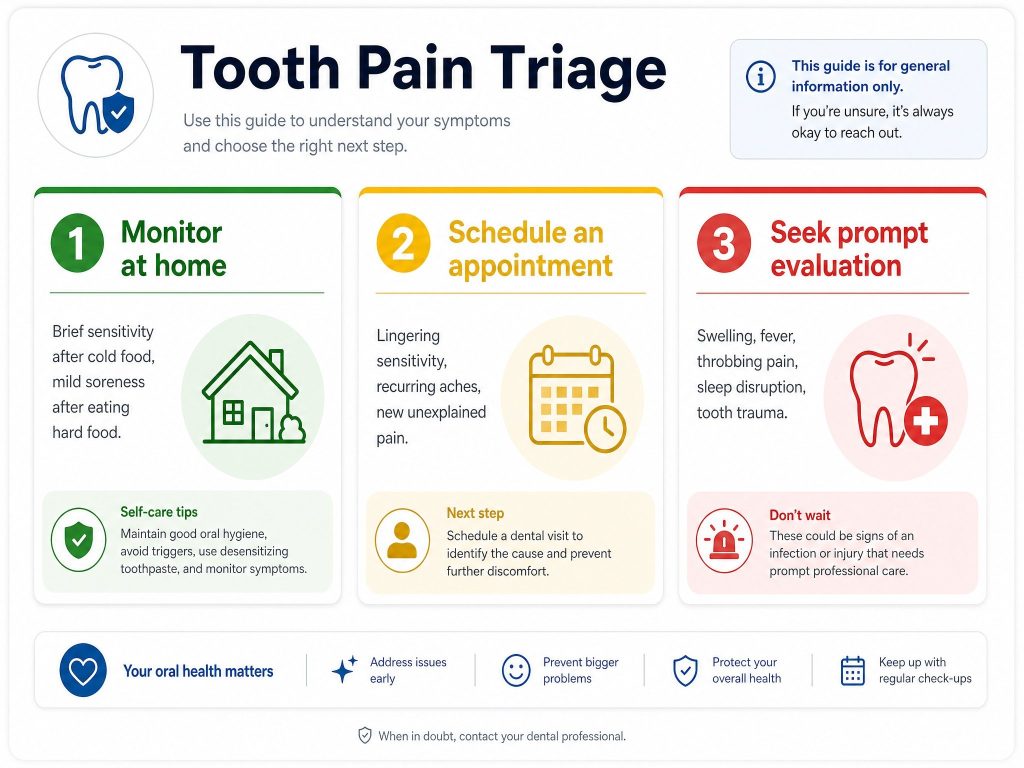
🟢 Monitor at home: Brief sensitivity after cold food that resolves quickly, mild soreness after eating something hard
🟡 Schedule an appointment: Sensitivity that lingers, recurring aches, new pain without obvious cause
🔴 Seek prompt dental evaluation: Swelling, fever, throbbing pain that won’t subside, trauma to the tooth, pain that disrupts sleep repeatedly
What Actually Happens During a Dental Exam
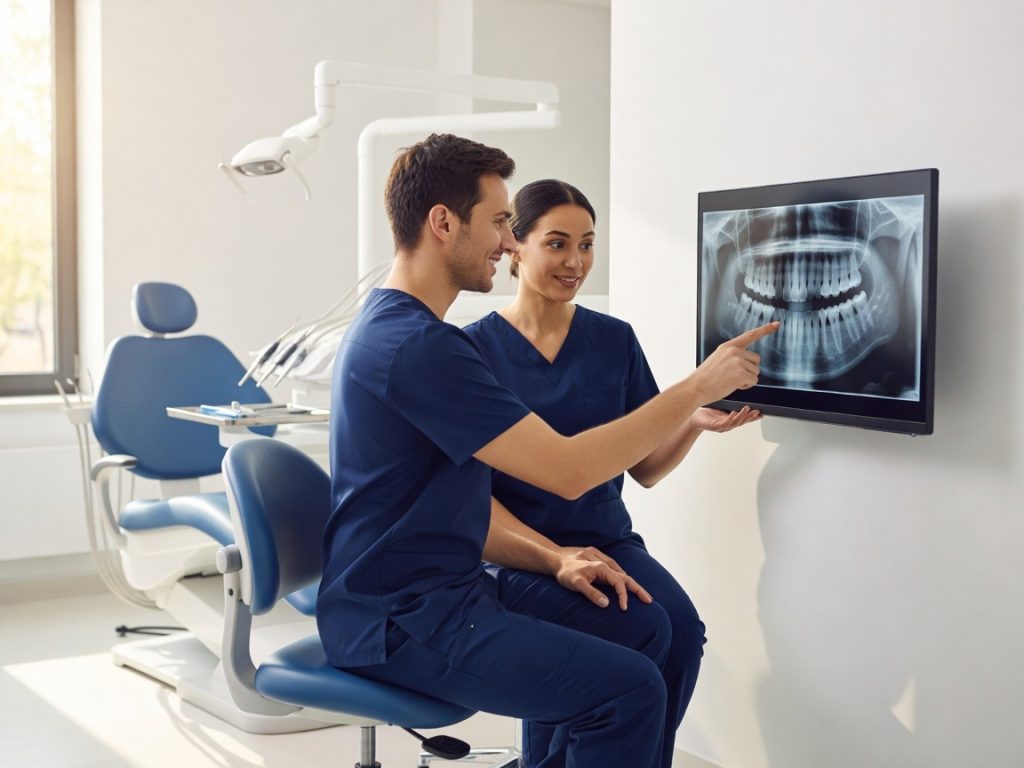
People avoid the dentist partly because they don’t know what to expect, and that uncertainty is its own kind of dread. An evaluation for tooth pain isn’t mysterious or complicated. A dentist — like Dr. Raj Khurana at Dental Care 4 U in South Holland — typically begins with a short conversation about your dental and medical history, then moves into a visual examination of the teeth and gum tissue. Digital X-rays reveal what the eye can’t catch: decay between teeth, bone changes, the condition of tooth roots, hidden fractures.
Depending on what’s found, a bite assessment may be done to isolate which tooth or teeth are reacting. Gum measurements might be taken if periodontal disease is suspected. Then comes the part most patients actually need: a clear explanation of what’s happening and what the options are. No guessing, no worst-case assumptions — just information.
Safe Things to Do at Home in the Meantime

If you can’t get an appointment immediately, there are a few conservative steps that can take the edge off without making things worse:
- Rinse gently with warm saltwater — it can reduce minor inflammation and keep the area clean
- Brush and floss carefully around the affected tooth; avoid skipping it out of fear
- Stay away from temperature extremes until you’re seen — very hot or cold foods will likely intensify sensitivity
- Over-the-counter pain relievers (ibuprofen, acetaminophen) taken as directed on the label can manage discomfort; the ADA recommends NSAIDs as more effective than opioids for acute dental pain
What home care won’t do is fix the underlying cause. A saltwater rinse doesn’t treat an abscess. Pain relief doesn’t stop decay from progressing. These are bridges, not solutions.
When to Book an Appointment in South Holland
If your tooth pain has lasted more than a day or two, keeps coming back, or is affecting how you eat and sleep — that’s the threshold. Don’t wait for the pain to become unbearable before picking up the phone. Dental problems addressed early are almost always less complicated (and less expensive) than the same problems addressed late. The impact of untreated dental disease extends well beyond the mouth — the CDC has linked it to over $45 billion in annual productivity loss in the U.S. alone.
Dental Care 4 U sees patients at 16270 Prince Dr., South Holland, IL 60473, and can be reached at (708) 333-2213. If you’re trying to figure out whether what you’re experiencing constitutes an emergency before calling, their dental emergency guide walks through the distinction in plain language.
Key Takeaways
Tooth pain is the mouth’s way of flagging that something deserves attention — but it’s not always a crisis, and it doesn’t automatically mean a root canal or extraction is in your future. The cause matters, and the cause can only be determined by an actual examination, not a symptom checklist.
Mild, fleeting sensitivity is different from throbbing nighttime pain with swelling. Knowing the difference between “monitor this” and “call today” is genuinely useful — and hopefully, this piece helped clarify that line. When symptoms persist, worsen, or worry you, that’s the moment to stop wondering and start getting answers.
Frequently Asked Questions
Is tooth pain something I should always worry about?
Not always. Tooth pain ranges from brief sensitivity to serious infection, and the same symptom can have very different causes. What matters most is whether the pain persists, worsens, or comes with other symptoms like swelling or fever — those warrant a dental evaluation.
Can tooth pain go away on its own?
Mild sensitivity sometimes resolves, especially if it’s triggered by something minor. Ongoing or recurring pain, though, usually points to something that isn’t going to fix itself. If it’s been more than a day or two and the ache keeps returning, don’t wait on it.
Does nighttime tooth pain mean something is seriously wrong?
Not necessarily, but it’s worth taking seriously. Blood flow changes when you lie down can amplify pressure around an inflamed tooth, making pain feel worse at night. If it’s consistently waking you up, that’s a signal to get it checked rather than ride it out.
Does a toothache always mean I need a root canal?
No — and this is one of the most common fears that keeps people from calling a dentist. Many causes of tooth pain are treated with a filling, a crown, gum treatment, or in some cases just a night guard for bruxism. A root canal vs. extraction decision is based on the specific condition of the tooth, determined through examination and X-rays.
Why does my tooth hurt more at night than during the day?
Partly physiology, partly psychology. Lying flat redistributes blood flow toward the head, which can increase pressure around inflamed tissue. And without daytime distractions pulling your attention, the brain registers pain more acutely. Persistent nighttime toothaches should be evaluated — it’s one of the more reliable signs that something needs professional attention.