Everyone’s seen the before-and-after photos. You know the ones. Some influencer flashes a blinding white smile and swears it happened from a $30 strip kit she bought at Walgreens. And sure, maybe it did — a little. But if you’ve ever actually stood under fluorescent bathroom lighting and squinted at the results of your own strip experiment, the story gets more complicated fast.
Professional vs at home teeth whitening comes down to more than just cost—they use different concentrations, timelines, and produce different levels of results.
Professional whitening is done in-office using high-concentration peroxide gels (about 25%–40%) under dental supervision, with protective barriers to shield gums and soft tissue. This allows for faster, more noticeable results, often in a single visit or a few sessions.
At-home whitening kits like strips, trays, or pens use lower concentrations (typically 3%–20%), which makes them safer for unsupervised use but slower to show results. These usually require consistent use over several weeks and may be less effective on deeper, intrinsic stains.
Both approaches can genuinely improve tooth color. That part is real. But “which one works” depends entirely on what kind of staining you’re dealing with, how your teeth and gums respond to peroxide, and what you actually mean by results — brighter for a week, or noticeably different for a year.
Quick Comparison: Professional vs. At-Home Whitening
| Category | Professional Whitening | At-Home Whitening |
| Speed | One visit, immediate results | 1–8 weeks of daily use |
| Peroxide Strength | 25%–40% (in-office) | 3%–20% (OTC) |
| Supervision | Dentist-guided | Self-directed |
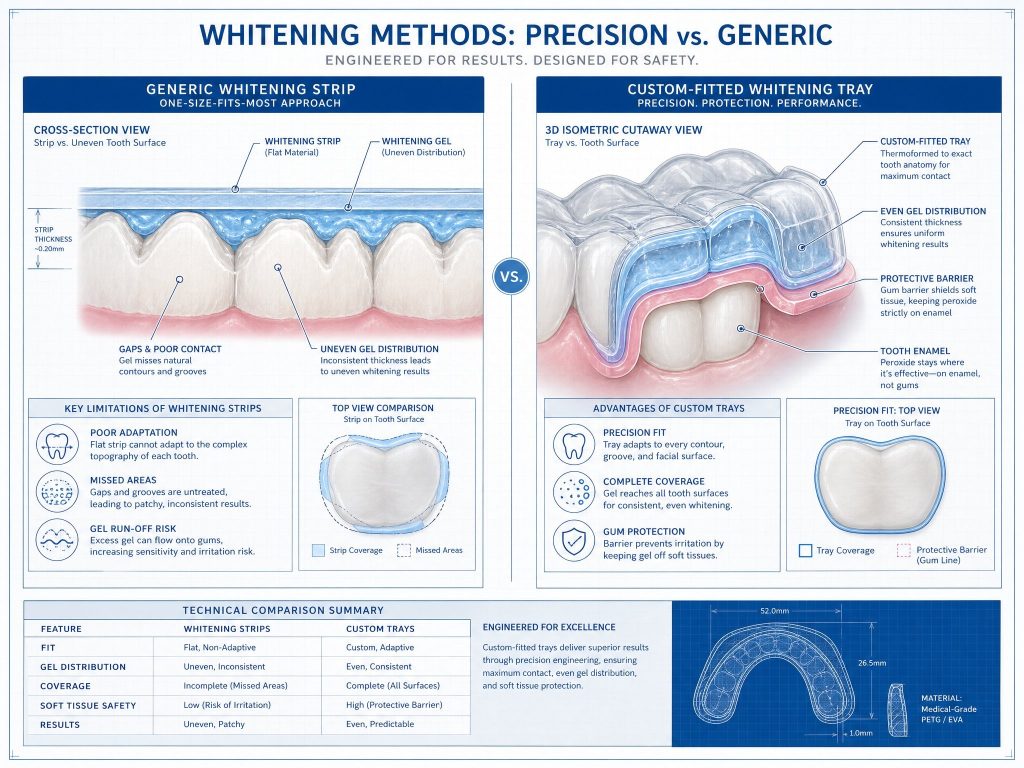
| Gum Protection | Custom barriers/trays | Generic fit, variable coverage |
| Cost (2026 est.) | $300–$800 | $20–$300 |
| Longevity | Often lasts 1+ year | Requires more frequent touch-ups |
| Sensitivity Management | Customized | Limited |
How Each Option Actually Works
Professional In-Office Whitening
You sit in the chair, a protective barrier gets applied to your gums — either a rubber dam or a resin-based gel — and then the dentist applies a high-concentration peroxide gel directly to your tooth surfaces. Some practices use an LED or laser light to accelerate the bleaching reaction, though 2025 research on professional LED treatments suggests the light primarily activates the gel faster rather than independently whitening teeth. The whole thing typically runs 60 to 90 minutes.
What makes this approach genuinely different isn’t just the stronger formula. It’s the precision. Coverage tends to be even across all visible tooth surfaces, including those awkward edges and in-between areas where strips notoriously miss. Intrinsic stains — the deep discoloration caused by things like old trauma, fluorosis, or certain medications — respond far better to professional-grade bleaching than they ever will to OTC alternatives, according to clinical analyses comparing bleaching techniques.
At-Home Whitening Products
The OTC market is genuinely crowded. You’ve got whitening strips, boil-and-bite trays, pens, LED kits, and whitening toothpaste, each with its own delivery mechanism and concentration ceiling. Strips are probably the most widely used — you press them against your teeth for 20 to 30 minutes daily, usually over two to four weeks. They work on extrinsic surface stains reasonably well. The limitation is fit. Generic strips don’t conform to tooth contours, so coverage is uneven, particularly on the sides and back faces of visible teeth.
Whitening toothpaste deserves a separate note: most don’t actually bleach. They rely on mild abrasives or low-dose peroxide to buff away surface pigment, which is more maintenance than transformation. LED home kits vary wildly in quality, and many consumer-grade versions don’t deliver the light intensity needed to meaningfully boost peroxide activation. OTC products are limited by lower concentrations of whitening agents, which caps how much shade change is realistically achievable.
Does at home whitening work? Yes, genuinely — for mild surface staining, with consistent use, and with realistic expectations about the degree of improvement.
- Whitening strips: best for mild-to-moderate extrinsic stains, 2–4 weeks of daily use
- Boil-and-bite trays: slightly better coverage than strips but still generic fit
- Whitening pens: useful for targeted spot maintenance, not full-mouth treatment
- Whitening toothpaste: maintenance tool, not a primary whitening method
- OTC LED kits: results vary significantly by product quality
Prescription Take-Home Kits
This is the middle ground people often don’t know exists. Your dentist takes impressions of your teeth and fabricates custom-molded trays that actually fit your specific bite. You get a professional-grade carbamide peroxide gel — typically 10% to 22% — to use at home for one to two hours daily over one to two weeks. The custom fit means the gel stays where it should and stays off your gum tissue, which matters a lot for both effectiveness and comfort. As Dr. Loren Grossman’s 2026 analysis notes, this approach delivers professional-grade results on a home schedule, making it a genuinely compelling option for people who want real improvement without blocking out 90 minutes in a dental chair.
What It’s Actually Going to Cost You
Cosmetic whitening is almost universally excluded from PPO dental insurance plans. That’s not a surprise to most people, but it’s worth confirming with your insurer before assuming anything. What you’re paying varies quite a bit by treatment type and provider location.
How much does professional whitening cost: In South Holland, IL and the surrounding south suburban Chicago area, estimates for 2026 run roughly in these ranges:
| Treatment Type | Estimated Cost Range |
| Whitening strips (OTC) | $20–$60 |
| Whitening trays (OTC) | $30–$100 |
| Whitening toothpaste | $5–$20 |
| OTC LED kit | $30–$300 |
| Prescription take-home trays | $150–$400 |
| In-office professional whitening | $300–$800 |
The gap between a box of strips and an in-office session looks enormous until you factor in what you’re actually buying. Multiple rounds of strips to chase the result you wanted the first time adds up. The sensitivity that sends you reaching for over-the-counter pain medication after a poorly fitted tray kit? That’s a real cost too, even if it doesn’t show up on a receipt.
If you’re in the South Holland area and thinking about professional cosmetic dentistry options, practices like Dental Care 4 U at 16270 Prince Dr., South Holland, IL 60473 offer consultations where you can get a cost estimate and discuss what’s realistic for your specific situation before committing to anything. Their number is (708) 333-2213.
The Timeline Question
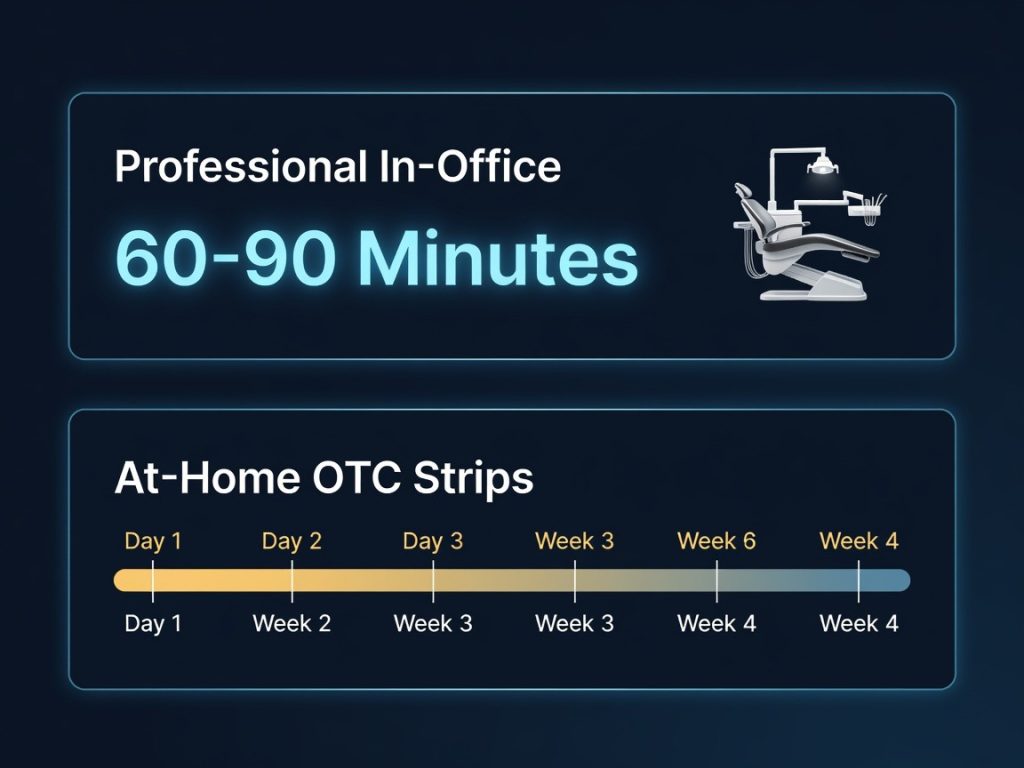
One in-office visit at 60 to 90 minutes versus two to eight weeks of daily self-application — that’s not a small difference if you have a wedding, reunion, or job interview coming up. Professional treatment lifts stains immediately and the result is visible when you walk out. At-home strips, even used faithfully every single day, often require the full two to four week window before the change is noticeable enough for other people to comment on.
Prescription take-home trays sit closer to the professional end of that spectrum: most patients see meaningful improvement within one to two weeks, especially with carbamide peroxide gel, which releases whitening agents gradually over the wear period and tends to cause less acute sensitivity than hydrogen peroxide formulas.
Maintenance matters for both. In-office results often hold for a year or longer with reasonable dietary habits — moderating coffee, tea, and red wine — while OTC results tend to fade more quickly and require more frequent re-treatment. That longevity gap is part of why professional treatments are considered worth the higher upfront investment by a lot of cosmetic dentists.
Safety and Sensitivity: The Honest Version
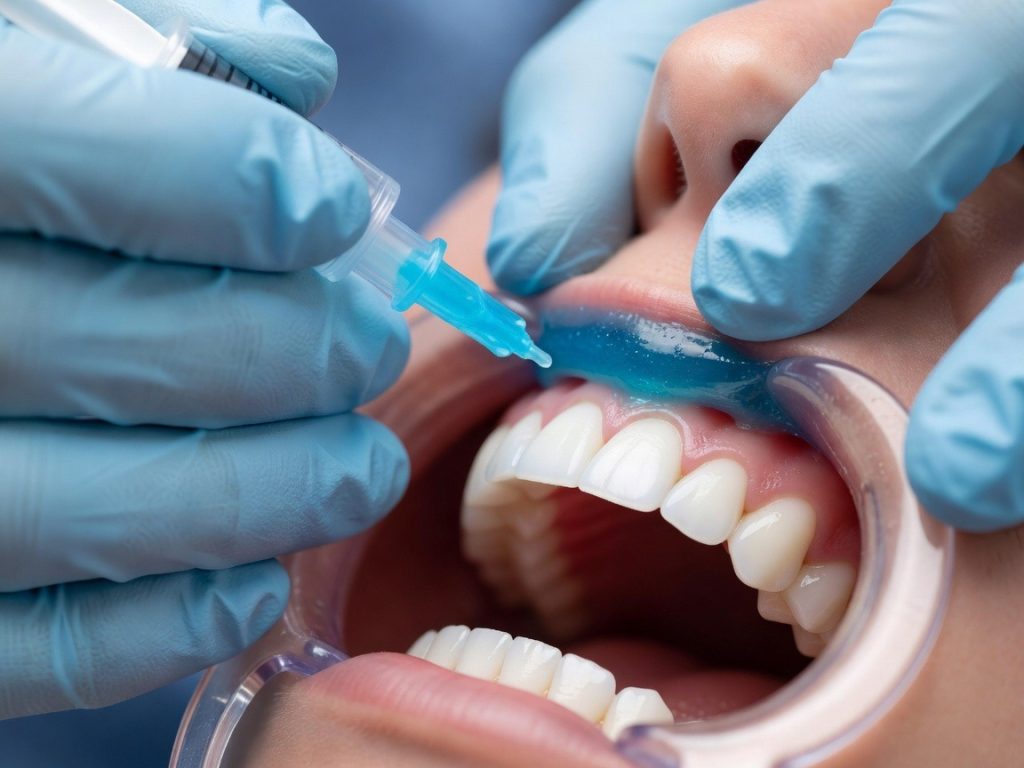
Temporary tooth sensitivity is the most common side effect of any peroxide-based whitening, professional or otherwise. It typically peaks in the first 24 to 48 hours after treatment and resolves on its own. The difference between professional and OTC experiences with sensitivity isn’t really about the ingredient — it’s about control. Custom barriers and properly fitted trays keep the caustic gel off gum tissue, which dramatically reduces gum irritation. Generic strips or trays that don’t conform well to your teeth are more likely to let gel migrate onto soft tissue, causing that sharp, localized gum sensitivity 1 tooth whitening users complain about.
There are also situations where whitening of any kind should wait. Cavities, active gum disease, cracked enamel, or exposed root surfaces need to be addressed before any bleaching regimen begins. The American Dental Association consistently advises consulting a dentist before starting whitening, particularly if you have pre-existing conditions like thin enamel or existing restorations. Fillings, crowns, and veneers don’t respond to peroxide the way natural tooth enamel does — they won’t whiten, which means professional evaluation is genuinely useful for understanding what outcome is even achievable given your current dental work.
One more thing worth flagging: truly DIY approaches — lemon juice, baking soda scrubs, activated charcoal — sit in a different category from regulated whitening products. Some of these methods cause enamel abrasion and produce patchy, uneven results at best. They’re not the same thing as OTC whitening products, and they carry real risks that the strip vs. professional debate doesn’t even touch.
Which One Should You Actually Choose?
Frankly, I’d push most people toward professional whitening if their budget allows it. The reasons aren’t mystical. Stronger formula, more even coverage, dentist-managed protection for your gums — it’s just a more controlled process. I’ve been in the bathroom-mirror situation after strips and seen that uneven front-face-versus-edge result firsthand. The patchiness is real, particularly if your teeth have any crowding or irregular contours where a flat strip simply can’t maintain contact.
That said, at-home options aren’t useless — they just require honest expectations.
Professional whitening tends to make more sense if:
- You want visible results before a specific event in the next two weeks
- You’ve had tooth sensitivity issues in the past and want gum protection managed by someone who knows what they’re doing
- Your staining is deeper or has been building for years
- You want the most uniform result possible
At-home whitening may be a reasonable starting point if:
- Your staining is mild and mostly surface-level
- You genuinely don’t mind a gradual four-to-six-week process
- Your budget is the primary constraint right now
- You’re comfortable following application instructions consistently
Only an oral examination can tell you whether whitening is actually appropriate for your teeth right now, and which approach has a realistic chance of getting you where you want to go. That context — knowing whether there’s a cavity that needs addressing first, or whether your existing crown placement affects how visible any whitening will be — is something no packaging or comparison chart can substitute for.
Common Questions Worth Answering Directly
Does whitening damage teeth? Peroxide-based products are generally considered safe when used as directed and when the person whitening doesn’t have underlying issues that would make them a poor candidate. Overuse, particularly with high-strength products and without professional oversight, can erode enamel over time. Following instructions and getting a professional assessment first is the practical safeguard.
Will whitening work on crowns or veneers? No. Restorative materials don’t bleach the way natural tooth enamel does. If you whiten your natural teeth significantly and have visible crowns or veneers in your smile zone, the contrast between them can become more noticeable, not less. This is a real conversation to have with your dentist before you start.
Why does sensitivity happen? Peroxide penetrates enamel and temporarily increases the porosity of dentin, which is the layer underneath. This lets temperature and pressure stimuli reach the nerve more easily than usual. It’s temporary, typically lasting 24 to 48 hours, and anti-sensitivity toothpaste used before and after treatment can help reduce it.
Can coffee and tea stain teeth again after whitening? Yes. Whitening isn’t a permanent alteration to enamel. Teeth continue to absorb chromogens — the pigment molecules — from food and drink. Results last longer with mindful habits: rinsing after coffee, using a straw for dark beverages, and scheduling maintenance touch-ups when you start to notice fading.
Talk to Dental Care 4 U Before You Decide

If you’re in the South Holland area and genuinely undecided, a cosmetic consultation at Dental Care 4 U gives you something comparison articles can’t: an actual look at your teeth. Dr. Raj Khurana can evaluate the cause of your staining, check for anything that should be addressed before whitening begins, and walk you through what professional treatment would realistically achieve for your specific smile — without pressure to commit on the spot.
The consultation typically covers a smile evaluation, a discussion of your goals, an oral health check, personalized whitening recommendations, a cost estimate, and a realistic timeline. That information is worth having before you spend another $40 on strips that may or may not deliver what you’re hoping for.
Dental Care 4 U is located at 16270 Prince Dr., South Holland, IL 60473. You can reach them at (708) 333-2213.
Frequently Asked Questions
How much does professional whitening cost in South Holland? In-office whitening in the South Holland, IL area generally runs between $300 and $800 depending on the treatment type and what’s involved. Prescription take-home trays are typically lower, in the $150 to $400 range. Costs vary by provider and individual treatment goals.
Does dental insurance cover whitening? Most PPO plans treat cosmetic whitening as an elective procedure and don’t cover it. Verify directly with your insurer, as benefits differ by plan.
How do I know which whitening option fits my situation? Your goals, the type and depth of staining, your sensitivity history, and your budget all factor in. A consultation with a dentist is the most practical way to get a recommendation that’s specific to your teeth rather than a generalized suggestion.
Does at-home whitening really work? For mild surface staining, yes — when used consistently and as directed. Results are more gradual and often less dramatic than in-office treatment, but noticeable improvement is achievable for many people.
Is teeth whitening safe? For most people, whitening is considered safe when products are used appropriately and dental health is confirmed beforehand. An examination can flag cavities, gum issues, or other conditions that should be treated first.