If you’ve ever caught yourself googling “Invisalign vs braces for adults” at midnight, half-hoping the internet will just make the decision for you — you’re not alone. Most adults walking into an orthodontist’s office for the first time (or the second time, because yes, teeth shift) already know the basics. What they actually want to know is: which one won’t make my life miserable for the next year and a half?
Straight answer: Invisalign generally wins for mild-to-moderate cases where discretion and lifestyle flexibility matter most. Traditional braces tend to be the stronger clinical choice for complex bite corrections, significant crowding, or cases where you’d rather not think about your orthodontic treatment every single morning. Neither is universally better. The right call depends heavily on your specific teeth, your discipline, and honestly — how much you trust yourself to follow through.
That said, the gap between these two treatments has narrowed considerably. A 2025 systematic review found overall efficacy sitting at 88–90% for clear aligners versus 90–91% for traditional braces in comparable adult cases, which is close enough that the clinical difference becomes almost secondary for a lot of people. What starts to matter more is everything else — cost, timeline, what it feels like to eat lunch, whether you want to explain brackets to your coworkers.
What You’re Actually Choosing Between
Invisalign works through a series of custom-fit clear aligners, each worn for roughly one to two weeks before you swap to the next tray. The whole system is built around digital treatment planning — your provider maps out the entire tooth movement sequence upfront, and you progress through the trays over time. The non-negotiable: you wear them 20–22 hours per day. That two-hour window is for eating, brushing, and flossing. Nothing else.
Traditional braces are brackets bonded directly to your teeth, connected by archwires that your orthodontist adjusts at regular appointments — typically every four to six weeks. There’s no compliance requirement in the same sense. They work continuously whether you’re thinking about them or not. For adults with more demanding orthodontic issues like severe rotations, significant overbite, or complex bite problems, fixed appliances give your provider a level of three-dimensional control over tooth movement that clear aligners genuinely can’t match in every case.
Which adults tend to go which direction? Professionals in client-facing roles almost always lean toward Invisalign, for obvious reasons. Adults redoing treatment after their teeth shifted in their 30s or 40s — often mild crowding, spacing issues — also tend to be solid candidates. Braces attract adults who want to hand the responsibility entirely to their provider, or those whose case complexity makes clear aligners a less predictable path.
The Cost Reality in 2026
This is where most comparison guides start hedging, and for good reason. Prices genuinely vary based on provider, geography, case complexity, and how long treatment ends up taking.
| Treatment | Estimated Range | Retainer (Post-Treatment) |
| Invisalign | $3,500 – $8,000 | $150 – $600 |
| Traditional Braces | $3,000 – $7,000 | $150 – $600 |
| Consultation | Often complimentary | — |
The cost gap has narrowed significantly — data from 2026 puts both treatments within a few hundred dollars of each other for comparable cases. Invisalign used to command a meaningful premium. That’s less true now. What does still drive price up on either side is case complexity: more trays, longer treatment, more adjustment appointments.
Insurance coverage is worth exploring before you assume anything. Many PPO dental plans now include orthodontic benefits that apply to both methods at similar rates, though the specific dollar amount and coverage percentage vary plan to plan. Financing options and monthly payment plans are standard at most practices — breaking a $5,000 treatment into small payments over 18 months changes the math considerably for most adults. Final treatment costs depend on diagnosis, case complexity, your insurance benefits, and your personalized treatment plan, so any number you see online is a starting range, not a quote.
How Long Does It Actually Take
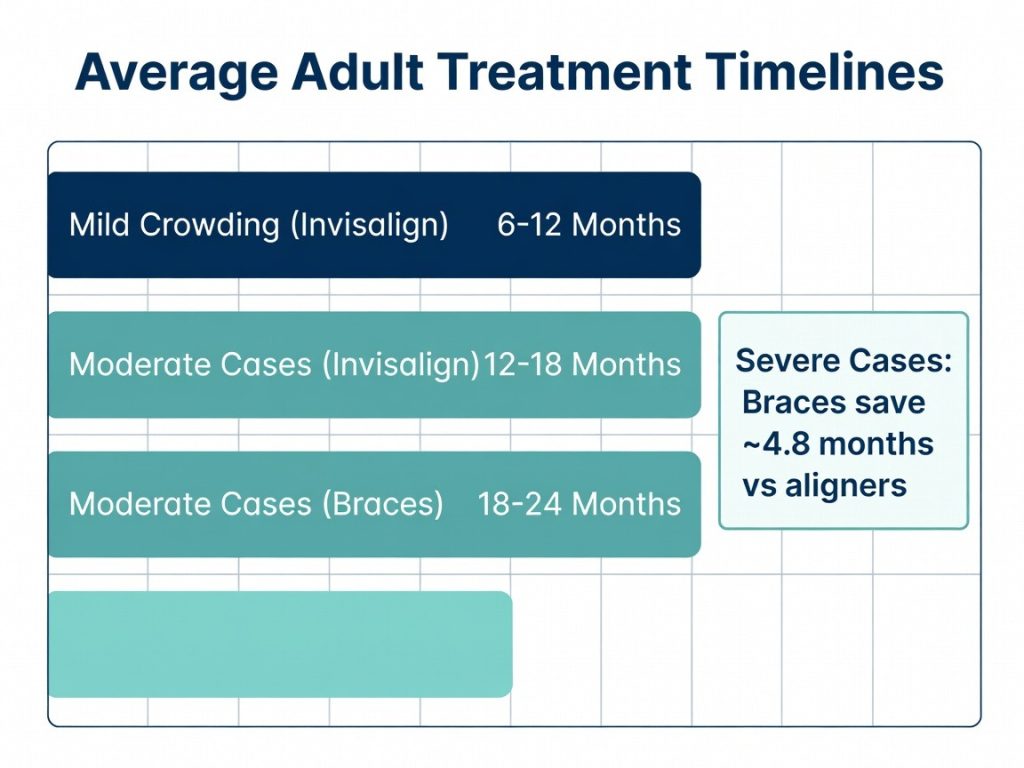
How long does Invisalign take? Treatment time depends on the complexity of your case. Mild crowding or spacing issues can often be corrected in 6–12 months, while most moderate cases take 12–18 months. More complex orthodontic issues may require longer treatment.
For comparison, traditional braces typically take 18–24 months for similar cases, although treatment with either option can be extended if the case is more complex..
A 2025 randomized controlled trial found that for severe cases specifically, traditional braces saved an average of 4.8 months compared to aligners. So the “Invisalign is faster” narrative is true in some cases and genuinely misleading in others. The honest answer is that treatment time tracks most closely with case complexity and — for Invisalign — patient compliance. An adult who consistently wears their aligners 22 hours a day will finish faster than the timeline suggests. Someone who routinely stretches that two-hour window will drag it out.
That compliance piece isn’t a small caveat. It’s arguably the central variable. Unlike braces, which are simply working in the background of your life, Invisalign hands you decision-making power every single day. Some people thrive with that. Others find that the flexibility collapses into inconsistency faster than they expected.
Comfort and Daily Life: What No One Warns You About
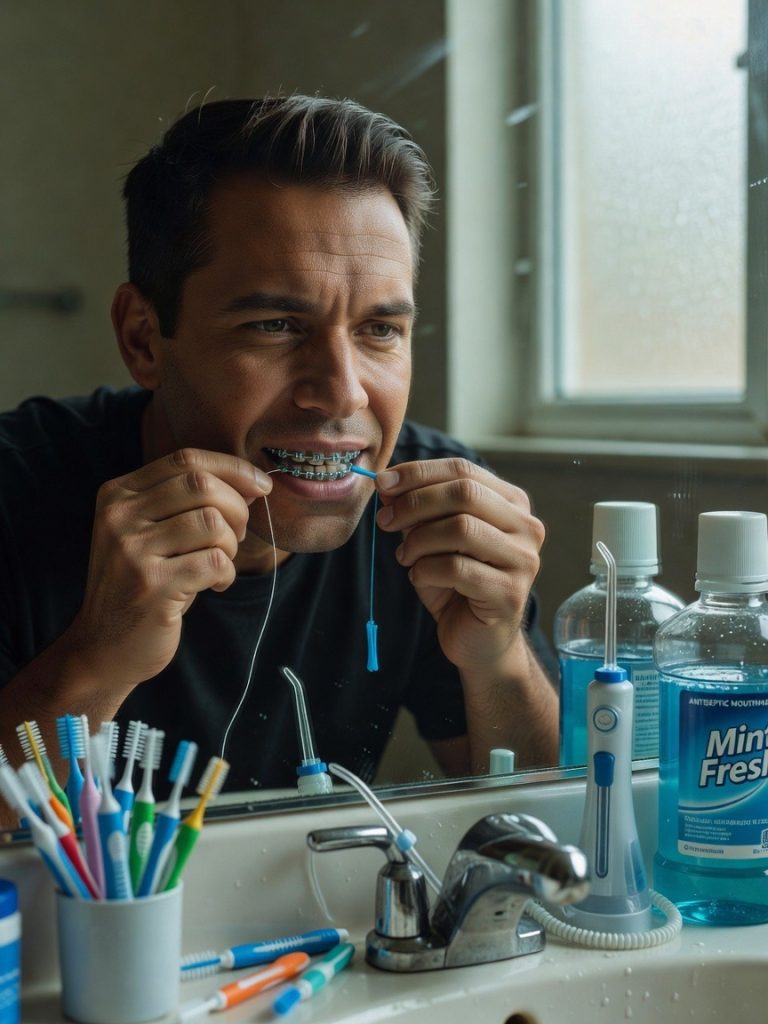
Braces hurt in a particular, persistent way — especially after adjustment appointments. Wires rubbing against the inside of your cheeks, soreness that lasts a few days after each tightening, the occasional canker sore. It’s manageable, but it’s a real physical presence in your mouth for the duration of treatment.
Invisalign discomfort tends to be more concentrated — pressure when you switch to a new tray, usually fading within a day or two. Clinical literature consistently shows patients report less mouth irritation and better speech outcomes with clear aligners compared to fixed appliances. That tracks with what actual patients describe: braces feel like something is always happening in your mouth, while Invisalign feels more like brief, scheduled pressure.
On the hygiene side, the difference is meaningful. With braces, flossing becomes a minor production — threaders, proxabrushes, rinsing more carefully around brackets. Studies on periodontal health during orthodontic treatment show significantly better gingival index scores in aligner patients, which makes intuitive sense: you remove the trays, brush and floss normally, replace them. Your routine doesn’t have to change much. Food restrictions with braces — no hard foods, no sticky foods, nothing that could pop a bracket — are a real lifestyle adjustment that some adults underestimate.
A few things worth knowing before you commit to either path:
- Adults of virtually any age may qualify for orthodontic treatment; bone density and gum health matter more than age itself
- Invisalign does cause a brief adjustment period for speech, usually resolving within a week or two
- Long-term success with either treatment depends heavily on retainer compliance after the active phase ends — skipping your retainer is how teeth shift back regardless of which method you used
- Complex tooth rotations and severe malocclusions remain areas where fixed appliances offer superior clinical predictability
How to Actually Make This Decision

Invisalign is only meaningfully better than braces if you wear it consistently. The moment compliance starts slipping — leaving trays out during long dinners, forgetting to put them back after a busy morning, taking them out at social events and not replacing them for hours — braces become the less frustrating option. Not because they’re more comfortable, but because they stop being a daily test of your own follow-through. They just work.
That said, for adults with mild-to-moderate alignment needs who genuinely will wear their aligners like they mean it, Invisalign’s discretion and lifestyle flexibility make it an easier experience in almost every practical dimension. Eating normally, maintaining oral hygiene without specialized tools, not having a visible metal apparatus in professional or social settings — those things add up over 12 to 18 months.
The scenario where braces become the clear recommendation: your orthodontic issues involve significant bite correction, severe rotations, or complex multi-plane movements. A 2025 study on complex case predictability confirmed that for genuinely complex presentations, fixed appliances are more clinically reliable. This isn’t a knock on aligner technology — it’s just the current state of what each system does best.
Deciding without a proper evaluation is, frankly, guesswork. Your teeth are specific to you. What looks like “mild crowding” to a non-clinician can involve bite nuances that change the treatment calculus entirely.
Frequently Asked Questions
How much does Invisalign cost in South Holland? Estimated ranges for the South Holland, IL area align with national averages — roughly $3,500 to $7,500 for most adult cases, depending on complexity and treatment duration. Insurance benefits and financing plans affect out-of-pocket cost considerably. Dental Care 4 U (16270 Prince Dr., South Holland, IL 60473 | (708) 333-2213) offers complimentary consultations where pricing is discussed alongside your specific treatment needs.
Does PPO dental insurance cover Invisalign? Many PPO plans include orthodontic benefits that apply to both clear aligners and traditional braces at comparable rates. Coverage amounts and percentage contributions vary by plan — the only way to know what applies to you is to verify your specific benefits before treatment begins.
Am I too old for Invisalign? Age alone isn’t the determining factor. Healthy gums and adequate bone density matter more than the number. Adults well into their 50s and beyond successfully complete orthodontic treatment regularly.
Which option hurts more? Both involve pressure and temporary discomfort. Braces tend to produce more sustained irritation from brackets and wires, particularly after adjustments. Invisalign discomfort is typically sharper but shorter-lived when switching trays. Individual experience varies.
How do I know which is right for me? You don’t, until someone who can see your actual teeth tells you. An in-person evaluation lets your provider assess the full picture — alignment, bite, bone structure, what movement is actually needed — and explain which treatment options make clinical sense for your situation. That’s the only honest answer to this question.