
Most people hear “deep cleaning” at the dentist and immediately think it’s just a longer, more aggressive version of the usual visit. It isn’t. Not even close.
A dental deep cleaning, clinically called scaling and root planing, is a periodontal treatment designed to address gum disease that has already advanced below the gumline. The distinction matters because regular cleanings, the kind you get every six months, are preventive. They remove plaque and tartar sitting above the gums on surfaces your toothbrush mostly handles on its own. Scaling and root planing goes somewhere your toothbrush physically cannot reach: the space between your gums and tooth roots, where bacterial buildup quietly causes the real damage.
If your dentist brought this up, it’s probably because they measured gum pocket depths during your exam, and those numbers were telling a story. Healthy pockets sit around 1 to 3 millimeters. Anything deeper signals that infection and inflammation have moved in, and routine prophylaxis won’t clear that out. So calling deep cleaning “just a deeper clean” is a bit like calling surgery “just a fancier bandage.” The intent, the tools, and the recovery are all different.
Here’s what the actual experience looks like, from the moment you sit down to the weeks that follow.
Deep Cleaning vs. Regular Cleaning: The Difference That Changes Everything
The table below makes the distinction concrete, because patients often leave their diagnosis more confused than when they walked in.
| Feature | Regular Cleaning | Deep Cleaning (Scaling & Root Planing) |
| Where it cleans | Above the gumline | Above and below the gumline |
| Purpose | Preventive care | Periodontal treatment |
| Who it’s for | Healthy or near-healthy gums | Gum disease management |
| Appointments | Single visit | Often split into two visits |
| Anesthesia | Rarely needed | Commonly used |
| Follow-up | 6-month recall | Periodontal maintenance every 3-4 months |
A regular cleaning, formally called prophylaxis, is a maintenance procedure. It assumes your gums are basically healthy and just need the surface reset every six months. Deep cleaning exists in a completely different clinical category. It’s a treatment, not maintenance. And it’s prescribed, not routine. If you’ve been told you need one, it’s because an examination, specifically periodontal probing and possibly digital X-rays, revealed signs of periodontitis that preventive care can’t reverse on its own.
When comparing deep cleaning vs regular cleaning, the main difference is the depth of treatment needed. Deep cleanings are often divided into multiple visits for a practical reason: treating one section of the mouth at a time allows your gums and tissues to recover more comfortably.
Many dentists complete the procedure by treating one side of the mouth first, then scheduling a follow-up visit a week or two later for the remaining areas. While some offices complete deep cleanings in a single longer appointment, the two-visit approach is common because it can be easier on your gums and overall comfort.
What Actually Happens During Scaling and Root Planing
Walking in without knowing what to expect makes the whole thing feel more intimidating than it needs to be. The procedure has a clear sequence, and knowing it ahead of time genuinely helps.
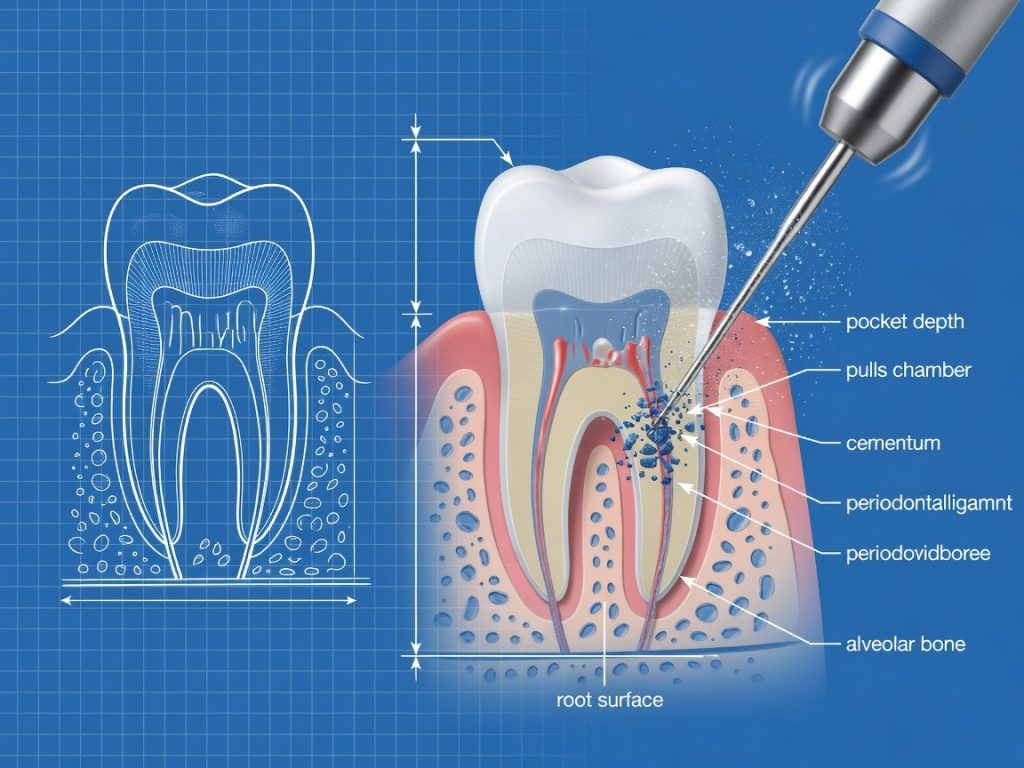
Before anything else, the hygienist or dentist conducts a clinical exam. Gum pockets are measured with a periodontal probe, a small instrument that charts how far the tissue has separated from your teeth. X-rays may be taken if bone loss is a concern. This isn’t just administrative prep, it tells the clinician exactly where the infection is concentrated and how deep the scaling needs to go.
Then comes the numbing. Local anesthesia is standard for this procedure, and if your provider doesn’t offer it proactively, ask for it. You’ll feel pressure and vibration throughout, but the sharp sensitivity that would otherwise make this genuinely painful gets blocked out. The anesthetic typically takes a few minutes to fully kick in, and once it does, most patients report that the appointment is uncomfortable rather than painful.
Scaling comes next. Using a combination of ultrasonic instruments and handheld scalers, the hygienist removes hardened plaque, dental calculus, and bacteria from tooth surfaces above and below the gumline. The ultrasonic device emits vibrations that break up tartar while simultaneously flushing the pocket with a fine stream of water. It’s efficient, but you’ll absolutely feel the buzzing sensation against your teeth roots.
Root planing follows immediately. This is the step that makes deep cleaning fundamentally different from anything done during a regular visit. The clinician smooths out microscopic roughness on the tooth root surface, because rough surfaces act like velcro for bacteria. By planing those surfaces smooth, they’re creating an environment where your gums can actually reattach to the tooth rather than staying inflamed and pulling away. A mouth rinse or antibiotic gel may be placed in stubborn pockets at this stage if the infection is significant.
Recovery: What the Days After Actually Feel Like

People consistently underestimate the recovery phase. The appointment might be manageable, but the day after is when your mouth announces it’s been through something.
Expect tenderness for two to four days. Gum tissue that’s been inflamed and then thoroughly debrided doesn’t bounce back instantly. Mild bleeding during brushing in the first week is common and doesn’t mean something went wrong. It usually means your gums were already inflamed and are now recalibrating. The distinction matters because patients sometimes panic and stop brushing altogether, which is exactly the wrong response.
Temperature sensitivity, especially to cold, can show up in areas where the root surface was exposed during treatment. This typically fades within one to two weeks, though it can linger longer if the gum recession was significant before the procedure even started. Ibuprofen handles the discomfort reasonably well for most people, and some providers will recommend a low-dose doxycycline afterward as part of the infection management protocol.
A few things that genuinely speed up healing:
- Use a soft brush and keep brushing, even when your gums are tender
- Avoid tobacco in any form for at least 72 hours, ideally longer, because smoking impairs gum healing in measurable ways
- Skip hard, crunchy, or spicy foods while the tissue is still raw
- A balanced diet helps tissue repair, so lean proteins and soft vegetables are solid choices for the first few days
The follow-up appointment, scheduled roughly four to six weeks out, is not optional. That’s when the dentist measures your pocket depths again to assess healing. According to Cleveland Clinic’s guidance on tooth scaling, consistent post-treatment monitoring is what separates successful outcomes from recurring cycles of infection.
Cost, Insurance, and What to Realistically Expect in 2026
Cost is one of the first things patients search for, and the range is wide enough to be confusing without context.
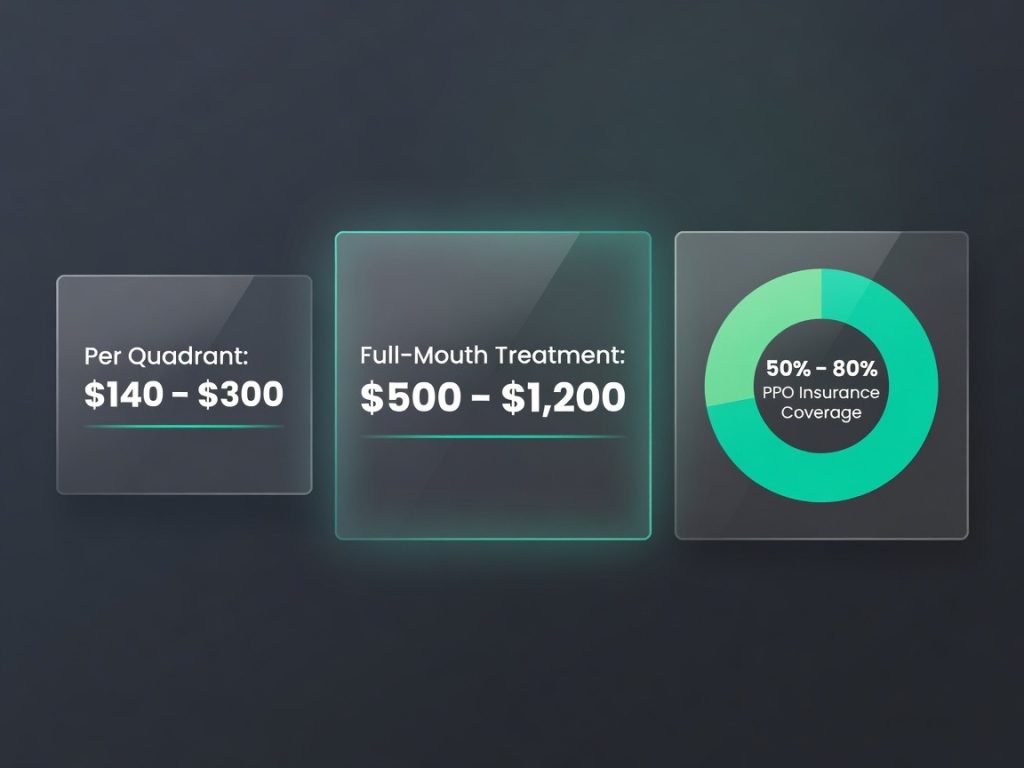
In 2026, scaling and root planing typically runs between $140 and $300 per quadrant. A full-mouth treatment covering all four quadrants lands somewhere between $500 and $1,200 out of pocket, depending on the practice, your geographic location, and the severity of your periodontitis. South Holland, IL practices like Dental Care 4 U may offer payment arrangements, and it’s worth asking about CareCredit if you’re managing costs across multiple visits.
Most PPO dental insurance plans do classify scaling and root planing as a medically necessary procedure, which means it typically falls under major restorative or periodontal benefits rather than the preventive bucket. Coverage often lands between 50 and 80 percent after your deductible, but annual maximums, which usually cap around $1,000 to $2,000, can affect how much of the treatment gets covered in a single benefit year. Asking the front desk to verify your PPO benefits before scheduling saves a lot of financial surprise later.
After the initial deep cleaning, periodontal maintenance visits, which replace your regular six-month recalls, are scheduled every three to four months. These aren’t the same as routine cleanings; they include continued monitoring of pocket depths and targeted cleaning of problem areas. Skipping them doesn’t just stall progress, it actively invites the infection to rebuild in the same spots that were just treated.
Why Skipping It Is a Bigger Gamble Than It Seems
Some patients push back on the recommendation. That’s understandable. Nobody wants to be told they need a procedure they weren’t expecting.
But periodontitis is a bacterial infection affecting the structures that hold your teeth in place. Bone loss, once it happens, doesn’t reverse. Gum tissue that recedes due to chronic inflammation doesn’t grow back on its own. A deep cleaning doesn’t cure gum disease, but it removes the bacterial load that’s actively driving the destruction, giving your immune system and your home care routine a fighting chance.
I suspect a lot of people frame it as a money grab because the recommendation can feel sudden. You go in for a regular cleaning, and suddenly you’re being told you need something different and more expensive. But gum pockets don’t develop overnight, and the clinical measurements don’t lie. What changes is the decision point, meaning the moment the damage crosses the threshold where preventive care stops being sufficient.
The honest version: a deep cleaning is a reset, not a permanent fix. Whether it stays a reset depends almost entirely on what you do after. Consistent home care, the follow-up evaluation, and maintaining periodontal maintenance appointments are what actually determine long-term gum health. Treating it as a one-and-done procedure is the thinking that brings patients back to square one.
Common Questions Worth Answering Directly
Does a deep cleaning hurt?
With local anesthesia, the procedure itself is typically manageable. Post-procedure soreness is real but temporary. Patients with severely inflamed gums often experience more discomfort afterward because the tissue itself is reactive, not because anything went wrong during treatment.
Why can’t a regular cleaning handle this?
Because a regular cleaning doesn’t reach below the gumline where the infection lives. The instruments, technique, and intent are fundamentally different. It’s not a matter of thoroughness; it’s a matter of access.
Will I need another deep cleaning later?
That depends on how well the gum pockets respond to treatment and whether home care habits change. Some patients maintain healthy pockets after one round of scaling and root planing. Others, particularly those with aggressive periodontitis or systemic health factors like diabetes, require periodic retreatment.
Can gum disease come back?
Yes. Bacteria are persistent, and without ongoing maintenance, pockets can deepen again. The goal of treatment isn’t to eliminate bacteria entirely; it’s to reduce the bacterial load to a level your body can manage. Consistent periodontal maintenance keeps that balance from tipping the wrong way.
If you’ve been told you need scaling and root planing and you’re still weighing whether to move forward, a periodontal evaluation is the most honest next step. At Dental Care 4 U, located at 16270 Prince Dr., South Holland, IL 60473, Dr. Raj Khurana reviews gum measurements, X-rays if indicated, and your full oral health picture before recommending any treatment. You can reach the office at (708) 333-2213 to schedule an evaluation and get a clear read on what your gums actually need rather than guessing based on what someone told you at your last appointment.