You’ve been putting it off. Maybe the insurance ended with the old job, maybe the last cleaning was two or three years back, and now you’re staring at your phone typing “dental cleaning near me no insurance” while quietly dreading the number.
Here’s the short answer. A routine cleaning without insurance in the South Holland, IL area usually lands between roughly $100 and $250, depending on whether an exam and X-rays are bundled in. National averages from GoodRx’s cleaning cost guide hover near $200. Call Dental Care 4U South Holland and ask for the all-in number before you book. Don’t guess.
Need one soon? Same-day openings depend on the schedule that day, so a phone call beats a drive-by every time.
Key Takeaways
- Dental cleaning without insurance typically costs $100–$250 in the South Holland, IL area when an exam and X-rays are included. A routine cleaning alone may cost $75–$200, while deep cleaning for gum disease costs more.
- You can find affordable dental cleaning near you without insurance by comparing self-pay rates, asking about in-office discount plans, or exploring dental schools and community health centers with sliding-scale fees. Always request an itemized estimate before treatment.
- Dental Care 4U offers a local option to ask about cleaning costs and appointment availability. Contact the South Holland office to confirm current cash prices, whether exams and X-rays are included, and the earliest available appointment.
How much is a dental cleaning without insurance near me in South Holland, IL?
Question: How much is a dental cleaning without insurance near me in South Holland, IL?
Answer: If you’re searching for how much a dental cleaning costs without insurance near you, a routine cleaning in the South Holland area typically ranges from $75 to $200 without insurance. A visit that includes an examination and X-rays may cost approximately $100–$250 or more, depending on the services provided. Patients looking for dental cleaning near me with no insurance can compare self-pay prices, dental savings plans, dental school clinics, and community health centers.
Those searching for cheap teeth cleaning near me should ask for an itemized quote before booking. Dental Care 4U is a local option for confirming current cleaning fees, available discounts, and appointment times. Actual prices vary by patient needs and office policies.
What Drives the Price Up or Down
A “cleaning” isn’t one product. It’s a menu, and the sticker shifts depending on what you order.
A standard adult prophylaxis (that’s the clinical word for a routine cleaning) removes plaque and tartar from healthy gums. The exam, a separate fee, is the dentist checking for cavities, gum problems, and anything odd in your oral health. X-rays come third. Bitewings are cheap, a full-mouth series or panoramic image is not. Put all three together and you’re at the higher end of the range, which is why the first-visit quote often surprises people.
Then there’s the deep cleaning. Scaling and root planing treats gum disease, it’s priced per quadrant of the mouth, and it can run several hundred dollars in total. Guardian’s procedure cost breakdown separates standard and deep cleanings for exactly this reason. Mixing them up is the single biggest source of sticker shock I see.
Other things push the number around: how long it’s been since your last visit (heavy tartar takes more time, sometimes two appointments), the office’s overhead, whether you’re a new patient, and your local market. Chicago’s south suburbs generally sit below downtown prices, though not by a dramatic margin.
| What you’re paying for | Typical cash range |
|---|---|
| Routine adult cleaning | $75 to $200 |
| Comprehensive or periodic exam | $50 to $150 |
| Bitewing X-rays | $25 to $75 |
| Full-mouth or panoramic X-rays | $75 to $200 |
| Deep cleaning (per quadrant) | $150 to $350 |
Treat that table as a ballpark, not a quote. HealthInsurance.org’s fee breakdown lands in similar territory, and individual offices vary.
Why Skipping It Costs More
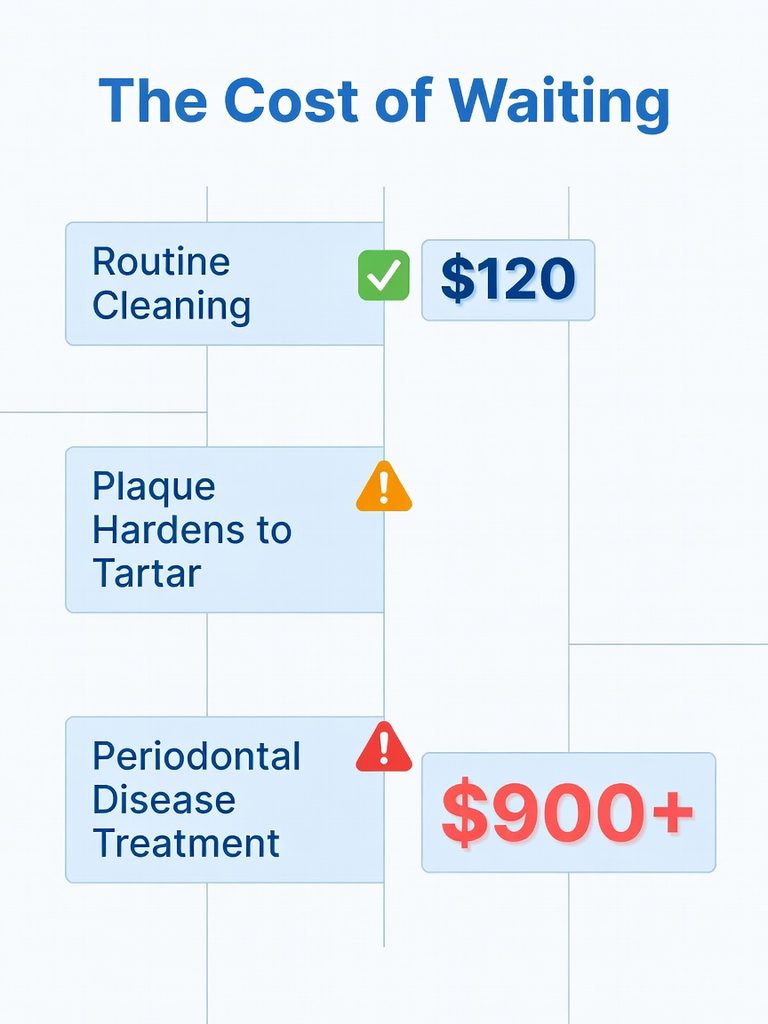
Frankly, the cheapest cleaning is the one you actually get. Plaque hardens into tartar within days, and no toothbrush will lift tartar once it’s set. Left alone, it irritates the gums, gingivitis follows, and periodontal disease can come after that. A $120 visit turns into a $900 treatment plan with a straight face.
Cost is the main reason people stay away, too. AARP’s research on dental barriers found that price and lack of coverage keep a big share of midlife and older adults out of the chair. You’re hardly alone in avoiding it. But avoidance compounds.
And one clarification worth making: Medicare, the federal program for people 65 and older, generally doesn’t cover routine cleanings under Original Medicare. People assume it does. It doesn’t.
Cheaper Ways to Get Your Teeth Cleaned
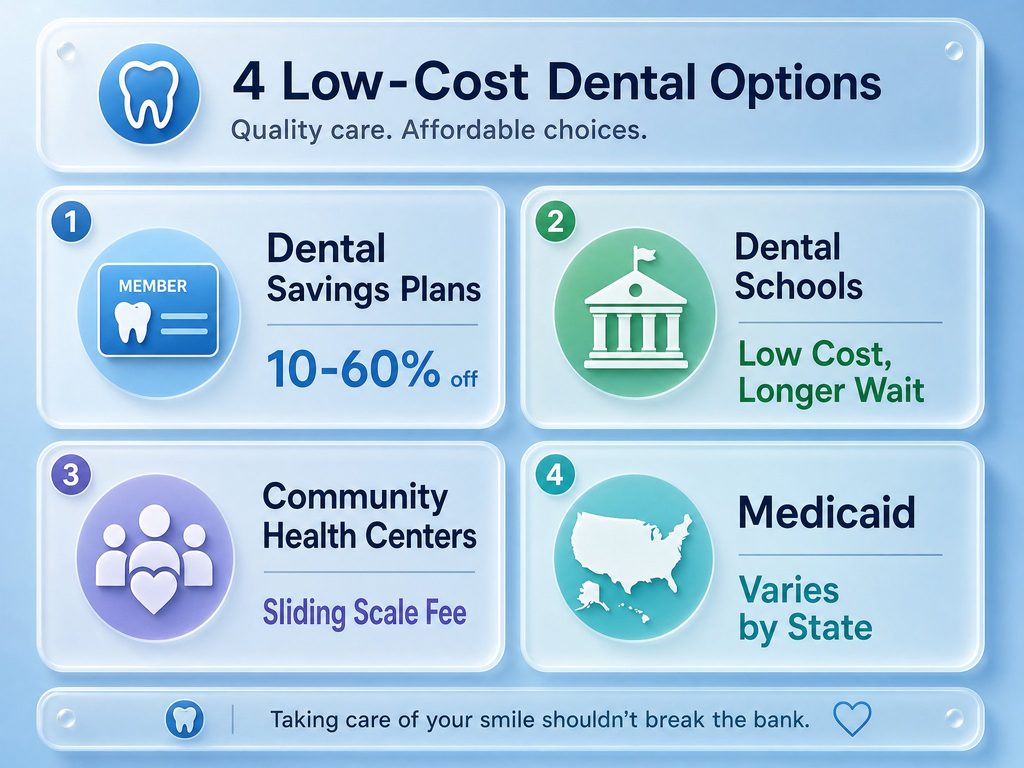
You have more options than you think. Some are better than others.
Dental savings plans. These aren’t insurance. You pay an annual membership fee, and participating dentists give you a discount, often 10 to 60 percent off. No waiting periods, no annual maximums, no claim forms. If you need a cleaning and a couple of fillings this year, the math can work well. If you need nothing, you’ve paid for a card. Ask the office directly whether it honors a specific discount plan, or whether it has its own in-house membership for uninsured patients. Plenty of practices do.
Dental schools and hygiene programs. Students work under licensed faculty, which means appointments run long (sometimes three hours) but cost a fraction of private rates. The NIDCR guide to finding low-cost care points people toward academic clinics first. Around Chicago, the UIC College of Dentistry and Midwestern University’s dental school in Downers Grove both run patient clinics, and community college dental hygiene programs nearby sometimes offer cleanings at a steep discount. Fair warning: expect screening appointments and waitlists.
Community health centers. Federally Qualified Health Centers charge on a sliding fee scale tied to your income, and many have dental departments. You can search the HRSA health center locator by ZIP code. Bring proof of income, and be patient, because demand outpaces capacity.
Medicaid. Adult dental benefits are a state decision, which makes this one uneven. Medicaid.gov’s dental overview explains that child dental coverage is mandated federally while adult benefits vary. If you’re enrolled in Illinois Medicaid, check what your plan covers before paying out of pocket.
Free and charitable programs. Mission of Mercy-style events and Dental Lifeline Network volunteers do real work, but these are mostly aimed at extensive treatment, and they run on specific dates. Fine as a backup. Not a plan.
Should You Just Pay Cash at a Private Office?
Sometimes, yes. Honestly.
Dental schools save money but cost time. Community clinics save money but may not fit your schedule. A private practice that quotes you a flat cash fee, offers a membership option, and can see you this week might be the better deal once you count a missed day of work. Time has a price too.
What matters is that you ask. A lot of offices will give you a discount for paying at the time of service, or bundle the exam, X-rays, and cleaning into a single new-patient price. Dental Care 4U South Holland is one place to ask, and any office should answer plainly when you do.
Booking Fast: Same-Day, Short Notice, and Walk-Ins
Need a cleaning before a wedding, a job start, or a trip? Fair. Here’s the reality, though: “walk-in” and “same-day appointment” aren’t synonyms. Showing up at the front desk doesn’t guarantee a hygienist has a free chair. A same-day appointment is a confirmed slot. A walk-in request might not become one.
I can’t tell you what any particular office’s policy is, and no article should pretend otherwise. Call and ask. Walking in unannounced, especially as a new patient with paperwork to fill out, is a gamble.
Say something like this:
- Tell them you want a routine cleaning as soon as possible.
- Say whether you’re a new or existing patient.
- Give them the days and times you can actually come.
- Ask for today first, then the earliest opening this week, then whether there’s a cancellation list.
Flexibility is the cheat code. Someone who can take a Tuesday at 10 a.m. gets seen faster than someone who insists on Saturday morning.
Before you hang up, ask what the visit will cost, whether the exam and X-rays are included, and what to bring. Mention any pain, swelling, or a broken tooth, too. A routine cleaning won’t fix those, and the office can steer you to the right appointment. Severe swelling or trouble breathing or swallowing? That’s an emergency room visit, not a phone tree.
What to Bring
Short notice doesn’t need to mean scrambled. Have these ready:
- Photo ID, if the office asks for one
- A list of your medications and any health conditions
- Insurance or discount plan card, if you have one
- Recent X-rays or the name and phone number of your previous dentist, so records can be requested
Don’t postpone a needed visit because old records are missing. The office will tell you what it needs.
What Actually Happens in the Chair
Expect a quick review of your dental and medical history, then the cleaning itself: scaling away plaque and tartar, polishing, flossing, and some personalized hygiene coaching. A dentist exam may come before or after, depending on your history and the office’s protocol.
Is a same-day cleaning any different from a scheduled one? The cleaning isn’t. What changes is the logistics: less time for paperwork ahead of the visit, and fewer choices on appointment times. Nobody gets worse treatment because they called Monday for Tuesday. But if your hygienist finds heavy buildup or signs of gum disease, you might leave with a deeper treatment recommendation instead of a finished cleaning. That’s not a bait and switch. That’s the exam doing its job.
Don’t Let the Number Win
The number looks smaller once you compare it to the alternative. A cleaning twice a year, roughly $200 to $400 annually at cash rates, is cheaper than a single root canal and crown, which can run well over $1,500.
So pick the path that fits. Savings plan, dental school, sliding-scale health center, or a private office that gives you a straight cash price. Then pick up the phone. Ask for the full cost, the earliest opening, and what to bring. Dental Care 4U South Holland is a reasonable first call if you want a local answer today.
Two minutes on the phone. That’s the whole barrier.
Frequently Asked Questions
How much is a dental cleaning without insurance near me?
Most adults pay about $100 to $250 for a cleaning with an exam and X-rays in the South Holland area, and less if the cleaning is billed alone. Deep cleanings cost more. Ask for an itemized quote before booking.
Can I get a same-day teeth cleaning?
Sometimes. It depends on that day’s schedule and your appointment type. Call before traveling, ask for today first, then the earliest opening this week, and ask about a cancellation list.
Is there a cheaper option than a private dentist?
Yes. Dental schools, community health centers using sliding fee scales, and membership savings plans can all lower the price. Each trades money for time, eligibility rules, or limited choices, so weigh that.
Do I need to call, or can I just walk in?
Call. Walking in doesn’t guarantee a chair, and new patients usually have paperwork to complete. A short phone call tells you exactly what the office can do.