You’re sitting in the dentist’s chair, jaw aching, X-ray clipped to the lightboard, and the dentist says those words: “You might need a root canal — or we could just pull it.” Your stomach drops. Because now you’ve got a decision to make, and absolutely nobody handed you a manual for this.
The honest answer to should I save or pull my tooth is: it depends on whether the tooth is actually restorable, and that’s something only a proper clinical exam with X-rays can confirm. But that answer alone doesn’t help you think through the tradeoffs before you walk into an office. So let’s do that together right now.
Root Canal vs. Extraction: The Quick Breakdown
Root canal vs extraction both address the same underlying issue: a tooth that is infected, severely decayed, or no longer structurally sound enough for a filling. The key difference is what happens afterward.
A root canal aims to save the natural tooth by removing the infected pulp, cleaning the inside of the tooth, and sealing it. An extraction, on the other hand, removes the tooth entirely and typically requires replacement options like an implant, bridge, or partial denture to restore function and alignment.
A root canal keeps your natural tooth in place by removing the damaged pulp (the soft inner tissue containing nerves and blood vessels), cleaning the canal system thoroughly, sealing it, and usually capping it with a dental crown. The tooth stays. It functions. You chew on it.
Extraction removes the tooth entirely. Simple extractions run faster and cost less upfront. But unless that gap is a back wisdom tooth nobody’s going to miss, you’re almost certainly going to face a replacement conversation soon after — because leaving a gap where a working molar used to be invites a cascade of problems: adjacent teeth begin to drift, bite mechanics shift, and jawbone density starts to decline from lack of stimulation.
Here’s a fast comparison before we go deeper:
| Factor | Root Canal | Tooth Extraction |
| Goal | Preserve natural tooth | Remove damaged tooth |
| Upfront Cost | Higher ($800–$1,500+ with crown) | Lower ($150–$300 simple; more for surgical) |
| Long-Term Cost | Crown may be needed | Replacement adds thousands |
| Recovery | Often a few days of sensitivity | Varies; surgical cases take longer |
| Bone Preservation | Yes | No — bone loss begins after removal |
| Bite Impact | Maintains alignment | May cause shifting without replacement |
The American Association of Endodontists consistently recommends root canal therapy over extraction when a tooth is salvageable, citing jawbone preservation, adjacent tooth stability, and long-term chewing function as the key reasons.
When Each Treatment Gets Recommended
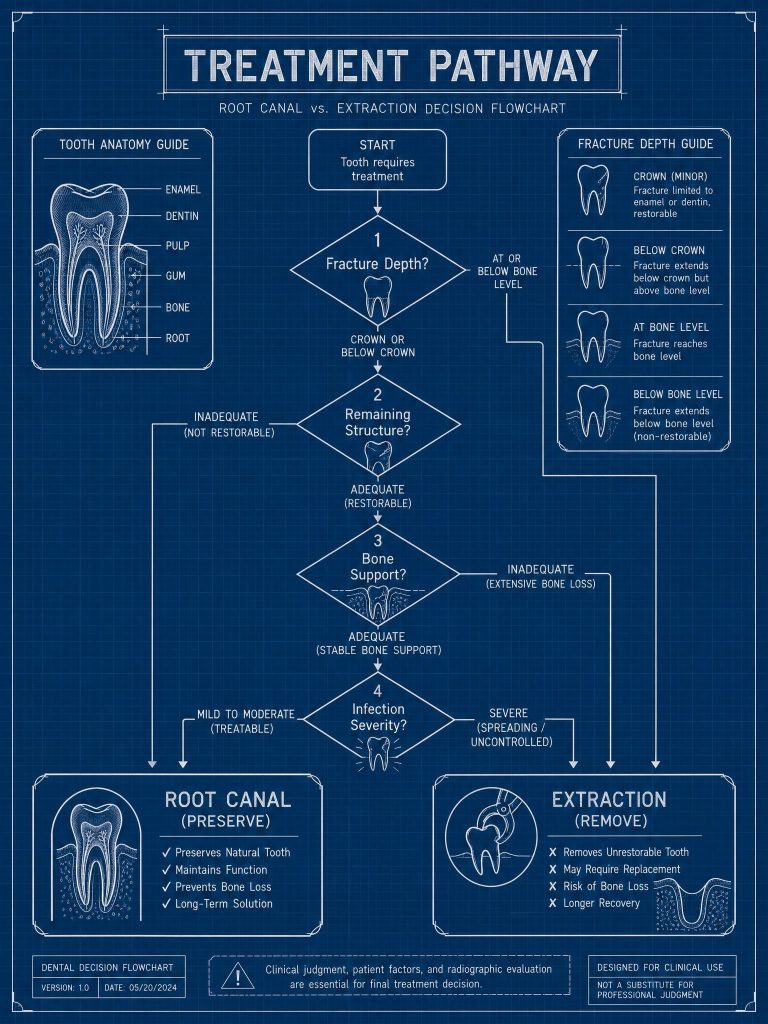
Root canal therapy tends to come up when there’s a live infection or deep decay, but the tooth still has enough healthy structure remaining to be restored afterward. Trauma to a tooth that cracked the enamel and exposed the pulp? Root canal. Deep cavity that reached the nerve? Same call. The endodontist’s job is to clean out what’s infected, close it off, and let the tooth keep doing its job for years — sometimes decades. Clinical data puts endodontically treated and crowned teeth at an 89–94% functionality rate after 10 years, which is a number worth taking seriously.
Extraction becomes the recommended path when the structural damage is simply too severe to rebuild from — fractures extending below the gumline, significant bone loss from advanced gum disease, or situations where there isn’t enough healthy tooth structure left to anchor a crown. Some teeth have been described as “basically beyond saving,” and trying to perform a root canal on one would be throwing money at a problem that isn’t solvable that way. In those cases, extraction isn’t giving up. It’s the right call.
The factors that usually tip the decision:
- Fracture depth — a crack above the gumline is treatable; one running vertically into the root often isn’t
- Remaining tooth structure — enough to support a crown post-treatment, or not
- Bone support — severe periodontal disease that’s destabilized the root changes the calculus entirely
- Infection severity — a contained abscess is manageable; spread into surrounding bone complicates things
Nobody can tell you which bucket your tooth falls into without looking at it in person and taking a digital X-ray. That part isn’t negotiable.
The Real Cost Picture (And Why It’s Messier Than You Think)
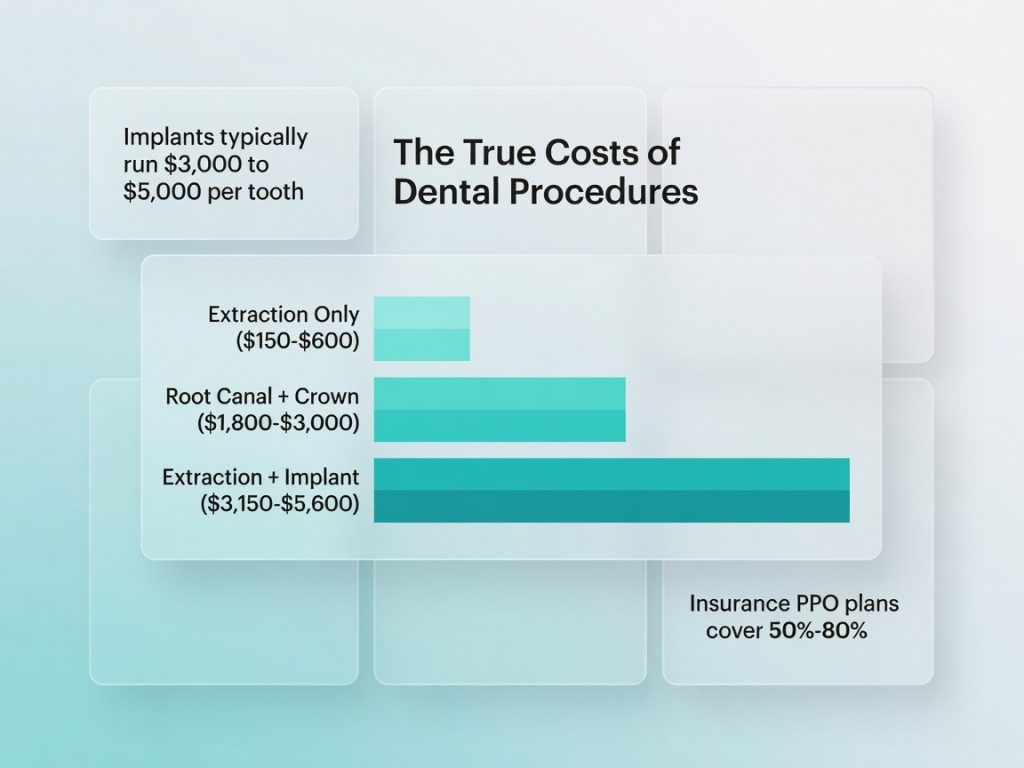
If you’re comparing these two options purely on what you pay this month, extraction wins. A simple tooth removal can run $150 to $300. A surgical extraction — for an impacted tooth or one with curved roots — can push $300 to $600. Root canal cost, depending on which tooth and how complex the canal anatomy is, typically range from $800 to $1,500 before you factor in a dental crown, which adds another $1,000 to $1,500 on average. So yeah, that’s a real number gap upfront.
But the “cheap” extraction has a footnote that doesn’t show up in the initial estimate. If you want to replace that tooth — and for most chewing teeth, you really should — implants typically run $3,000 to $5,000 per tooth, bridges can range from $2,500 to $5,000 depending on how many teeth they span, and partial dentures are the most affordable replacement option but come with their own limitations. When you add those numbers to the extraction cost, the “cheap” route doesn’t look cheap anymore.
Research published in peer-reviewed health economics literature found that preserving a tooth through endodontic treatment yields better quality-adjusted life outcomes when you account for the total cost of tooth replacement over a patient’s lifetime. I suspect a lot of people who chose extraction for budget reasons didn’t realize they were essentially deferring a larger bill, not avoiding one.
Insurance complicates this further. Many PPO dental plans cover a percentage of both root canals and extractions — often 50% to 80% for major restorative work — but annual maximums (commonly $1,000 to $2,000 per year) can still leave you with significant out-of-pocket exposure, especially once the crown enters the picture. If you’re in the South Holland area and want to understand what your specific plan covers before committing, that’s absolutely a conversation to have before your procedure, not after.
Recovery: What the First Week Actually Looks Like

Root canal recovery tends to get a worse reputation than it deserves. The procedure itself happens under local anesthesia — you feel pressure, not pain — and most people report the worst part is just keeping their mouth open for an extended period. Post-procedure soreness is normal and usually manageable with over-the-counter pain relief for a few days. The tooth may feel a little tender when biting down while healing, but most patients return to normal function pretty quickly.
Extraction recovery varies more. A simple pull heals without much drama. Surgical extractions — particularly for teeth with complex roots — mean real swelling, more significant discomfort, and a healing window that can stretch one to two weeks. There’s also the dry socket risk if the blood clot in the extraction site gets dislodged, which is uncomfortable enough that you’ll want to avoid it by following aftercare instructions closely.
One thing people underestimate with extraction: the gap doesn’t just sit there quietly. Once the tooth is gone, bone resorption begins at that site, which is why implants placed sooner rather than later tend to have better outcomes from a bone integration standpoint.
Pros, Cons, and the Honest Tradeoffs

Neither of these is a perfect option. Both involve tradeoffs you should walk into with eyes open.
Root canal therapy preserves what you already have — your natural tooth structure, your bite alignment, your jawbone density. Patients in systematic reviews report fewer long-term dissatisfaction outcomes compared to extraction followed by prosthetic replacement. The downside is the upfront cost and the additional crown appointment. And not every tooth is a candidate, which means you can’t always choose this path even if you want to.
Extraction removes the problem quickly and decisively. In cases where the tooth genuinely cannot be saved, it eliminates the source of infection and pain efficiently. The complications come afterward — the gap, the potential shifting, the replacement conversation. Studies tracking implant complications show that while single-tooth implants have high survival rates (94–97%), they carry roughly a 20% biological complication rate over time, including peri-implantitis, which is essentially gum disease around an implant. That’s not a reason to avoid implants — they’re excellent when needed — but it’s a reason to understand that “just pull it and put in an implant” isn’t consequence-free either.
My honest lean, for what it’s worth: if the tooth is restorable, the root canal path is the investment that tends to pay off. The people who describe regretting the “cheap pull” almost always describe it the same way — they didn’t realize the replacement cost was coming, and then it came.
The Decision Framework (Before You Walk In)

Before you sit down for your evaluation, it helps to have a mental checklist of what actually matters in this decision:
- Is there enough remaining tooth structure for a crown to grip onto?
- How is the surrounding bone health — any sign of significant periodontal disease?
- What’s your realistic budget, including the possibility of a crown or future replacement?
- Is this a high-function tooth (molar, premolar) or one that does less chewing work?
- What are your long-term dental goals — are you planning other restorative work anyway?
None of those questions have a universal right answer. A younger patient with one damaged molar and otherwise healthy bone support has a very different calculus than someone dealing with systemic gum disease across multiple teeth. That context is exactly why only an examination and current X-rays can produce a reliable recommendation — not a cost comparison article, not Reddit, and not well-meaning relatives with opinions.
Getting a Personalized Answer at Dental Care 4 U
If you’re in South Holland and you’re trying to figure out whether your tooth can actually be saved, that’s exactly the kind of evaluation Dental Care 4 U handles at 16270 Prince Dr., South Holland, IL 60473. The exam includes a clinical look at the tooth, digital X-rays, a rundown of your treatment options, estimated costs, and a review of what your insurance may cover. You can reach them at (708) 333-2213 to schedule.
The goal of that appointment isn’t to pressure you into a procedure — it’s to give you the information you need to make the call yourself, with a professional actually looking at your specific situation. That’s the only way this decision gets made well.
Frequently Asked Questions
How much does a root canal or extraction cost in South Holland? Root canal cost in the South Holland area typically range from $800 to $1,500 depending on the tooth and complexity, usually followed by a crown at an additional $1,000 to $1,500. Simple extractions run $150 to $300; surgical cases can be higher. Replacement options like implants add significant cost on top of that.
Does PPO dental insurance cover these procedures? Many PPO plans offer benefits for both root canal therapy and tooth extractions, typically covering 50% to 80% of the procedure cost for major restorative work. Annual plan maximums and specific coverage details vary, so verifying your benefits before treatment is worth the phone call.
How do I know which option is right for me? The condition of the tooth, surrounding bone structure, infection status, and your long-term oral health goals all factor into the recommendation. A dental exam with X-rays is the only reliable way to evaluate whether the tooth is restorable.
Is a root canal worth it? When a tooth can be predictably restored, preserving it tends to offer better long-term value — functionally and financially — compared to extraction followed by replacement. That said, not every tooth should be saved, and sometimes extraction is genuinely the right answer.
Can I replace a tooth after an extraction? Yes. Dental implants, bridges, and partial dentures are all potential replacement options depending on your bone health, budget, and surrounding tooth structure. The right fit depends on your individual circumstances, which is something to discuss during your evaluation.