At Dental Care 4 U, we understand that you’ve probably sat in a waiting room, clipboard in hand, wondering whether you’re about to receive a bill you weren’t expecting. For many people, the biggest source of stress isn’t the dental procedure itself—it’s the uncertainty surrounding insurance coverage. Understanding whether your dentist actually accepts your plan can be one of the most confusing parts of getting dental care.
Our team is here to help make that process easier by verifying your benefits, explaining your coverage, and providing clear cost estimates before treatment whenever possible. That way, you can focus on your oral health instead of worrying about surprise expenses.
If you’re wondering, “Does my dentist take my insurance?”, here’s what you need to know upfront: a dentist accepting your insurance and being in-network with your dental plan are not the same thing. That distinction alone has caused many patients to leave an appointment with a much larger bill than they expected.
The good news is there are concrete steps you can take before you ever schedule an appointment, and they’re not complicated once you understand how dental insurance networks, benefits, and reimbursement actually work.
If you have a PPO (Preferred Provider Organization) plan, you likely have more flexibility than you think, but flexibility without verification is how surprises happen.
PPO Dental Insurance: What You’re Actually Buying
Most employer-sponsored dental coverage in the United States runs on a PPO framework. According to NADP’s 2025 enrollment data, Dental Preferred Provider Organizations account for roughly 89% of dental plan enrollment, which means the odds are good that if you have dental insurance through work, you have a PPO. But what does that actually get you?
PPO dental insurance explained: A PPO (Preferred Provider Organization) plan gives you access to a network of dentists who have agreed to pre-negotiated fee schedules with your insurance company. When you visit one of these in-network providers, the cost of services such as cleanings, X-rays, or fillings is limited to the negotiated rate rather than the dentist’s standard fee.
Your insurance then pays its share of that negotiated amount, and you pay the remaining balance, which is typically much lower than what you’d pay at an out-of-network dental office. While PPO plans generally allow you to see any licensed dentist, choosing an in-network provider usually results in the greatest savings and the most predictable out-of-pocket costs.
The flip side is that PPO plans usually still allow you to see providers outside the network. You won’t be totally denied coverage. The catch is the insurer typically reimburses based on what they’d pay in-network, and you’re responsible for anything above that sometimes called “balance billing.” That gap can be $50 or it can be $300, depending on the procedure and your specific plan. This is exactly why the American Dental Association emphasizes the difference between a dentist who has signed a participating provider agreement versus one who hasn’t. The contract is what legally caps the fees.
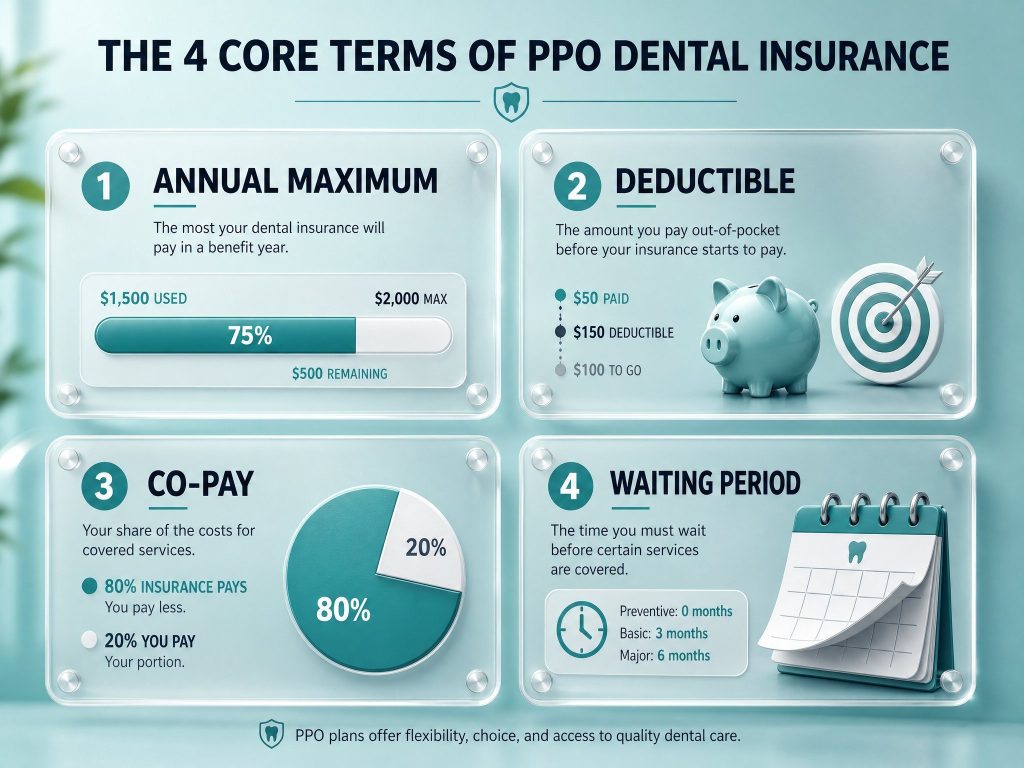
A few terms worth having in your vocabulary before you make any calls:
- Annual maximum: The ceiling on what your insurance pays per year. Once you hit it, you cover 100% until the plan resets.
- Deductible: What you pay out of pocket before insurance kicks in — often $50–$100 for individuals.
- Co-pay / patient portion: Your share of a covered service, often expressed as a percentage (like 80/20 for basic services, meaning insurance covers 80% after your deductible).
- Waiting period: Some plans won’t cover certain procedures — like crowns or orthodontics — until you’ve been enrolled for 6–12 months.
Every single plan has its own version of these numbers. Two people at the same company with “Delta Dental PPO” can have wildly different benefits depending on which tier their employer chose.
In-Network vs. Out-of-Network: The Part That Actually Bites People

The U.S. dental insurance market hit roughly $126 billion in 2025, and the overwhelming majority of it flows through PPO networks. So when a dental office says “we take your insurance,” what they often mean is they’ll file a claim on your behalf. That’s not nothing — but it’s not the same as being in-network.
When comparing an in-network vs out of network dentist, the biggest difference comes down to pricing and predictability. An in-network dentist has a contract with your insurance company and agrees to accept pre-negotiated fees for covered services. That means your treatment costs are generally more predictable, and your out-of-pocket expenses are often lower.
An out-of-network dentist may still accept your insurance by filing claims on your behalf, but they are not bound by your insurer’s negotiated fee schedule. They can charge more than your insurance reimburses, leaving you responsible for the remaining balance. Understanding this distinction before scheduling an appointment can help you avoid unexpected dental bills.
| In-Network Dentist | Out-of-Network Dentist | |
| Fee schedule | Contracted and capped | Set by the provider |
| Insurance pays | Per negotiated rate | Often based on “usual and customary” fee |
| Your portion | Generally lower and predictable | Potentially higher and variable |
| Claim filing | Handled by the office | Usually handled by the office, but reimbursement varies |
I’ve seen this play out in real life and over on Reddit’s r/MedicalBill, it’s basically a recurring theme where patients share stories of offices that said “insurance will cover it” and then sent a bill weeks later. The consensus from those threads is consistent and worth taking seriously: front-office estimates are not guarantees. You are legally responsible for the balance regardless of what the receptionist said on the phone.
Being out-of-network doesn’t automatically make a dentist a bad choice, by the way. Some of the best providers in a community don’t participate in any networks — they’ve made a business decision to avoid the reimbursement limitations that come with those contracts. The ADA’s guidance on third-party payer relationships notes that participating provider agreements bind dentists to specific fee schedules, which means excellent dentists sometimes opt out entirely to maintain pricing autonomy. The important thing is that you go in knowing that, not discovering it after the fact.
How to Actually Verify Coverage Before You Go

Most of the confusion in this space is preventable. The problem is that neither side — the insurance company nor the dental office — has a strong incentive to proactively hand you the clearest possible picture. The U.S. Office of Personnel Management is direct about this: their own guidance warns that provider directories can lag by months, which means even the insurer’s own website might list a dentist as in-network when that contract has already lapsed.
So here’s what actually works:
- Identify your exact plan name — not just the carrier. “Delta Dental PPO” and “Delta Dental PPO Plus Premier” are different products with different network participation rules.
- Call the dental office directly and ask specifically: “Are you in-network for [Plan Name], not just the carrier?” That distinction matters.
- Ask about the specific procedure, not just the general appointment. A dentist can be in-network for cleanings but not for orthodontics or implants depending on how their contract is structured.
- Get it in writing — a portal message, email confirmation, or at minimum a screenshot of the conversation. Phone conversations are genuinely too slippery. I personally won’t commit until I have something I can reference later if billing gets messy.
The American Dental Association recommends asking whether a provider is an “in-network participating provider” rather than the vague “do you take my insurance” question — because “we take your insurance” can simply mean they’ll file the claim out-of-network. That phrasing matters more than people realize.
What Your Costs Might Actually Look Like
The figures below are ranges based on typical 2025–2026 market data for common dental services. Actual costs will always depend on your specific plan, deductible status, and annual maximum remaining.
| Service | Without Insurance (Est.) | With In-Network PPO (Est. Patient Portion) |
| Routine Exam | $75–$150 | $0–$20 (often 100% covered preventive) |
| Bitewing X-rays | $50–$150 | $0–$30 |
| Adult Cleaning | $100–$200 | $0–$40 |
| Filling (composite) | $150–$300 per tooth | $30–$100 depending on plan |
| Crown | $1,000–$1,800 | $300–$700 depending on coverage tier |
Preventive care — cleanings, exams, X-rays — is where PPO plans tend to shine. Most plans cover those at 80–100% with no deductible, which is exactly why in-network verification is most valuable for anything beyond a routine visit. If you’re looking at a crown or a filling, the cost gap between in-network and out-of-network becomes genuinely significant.
Common Situations That Trip People Up

Your insurance card doesn’t list any dentists. That’s normal for PPO cards. The card just identifies your plan — the network lookup happens online or via phone. Don’t take a blank card as a sign you have no coverage.
The office says they “think” they take your insurance. That’s a red flag, not a reassurance. If an office can’t confirm their own network participation, I’m genuinely skeptical that billing will go smoothly later. An organized front desk knows this information or can find it within minutes.
Your plan changed during open enrollment. Even if you’ve seen the same dentist for years, a plan change — even within the same carrier — can alter network participation. Re-verify every time your plan resets or after any employer benefits change.
You’re told your coverage is guaranteed. It isn’t. Insurance carriers make the final call on every claim based on your policy documents, not what a front desk employee estimated. If a dentist’s office tells you something is definitely covered, ask them to note it in your chart — and still budget for the possibility that the insurer disagrees.
Making the Call: How to Decide What’s Right for You

If you have a PPO and you’re deciding between dentists — or trying to figure out whether to stay with your current provider — the framework isn’t complicated, it’s just honest.
If cost is the primary concern, the math almost always favors in-network. The contracted fee schedule removes ambiguity and usually results in lower out-of-pocket totals, especially for anything beyond a cleaning. If there’s a specific dentist you trust deeply and they’re out-of-network, that’s a legitimate reason to pay more — but go in knowing the number, not discovering it after the fact.
For new patients in South Holland researching coverage options before booking, Dental Care 4 U (16270 Prince Dr., South Holland, IL 60473 — reachable at (708) 333-2213) offers a pre-visit PPO benefits check that walks through your specific plan before you ever sit in the chair. That kind of upfront clarity is honestly how the process should work everywhere.
Frequently Asked Questions
Can I use my PPO insurance even if the dentist is out of network? Usually, yes. Most PPO plans still provide partial coverage for out-of-network services, though your patient portion will likely be higher than it would be in-network.
What information do I need to verify coverage? Your insurance carrier name, your exact plan name (not just “PPO”), your member ID, and the name of the specific dentist or practice you’re asking about.
How long does insurance verification take? A dental office with a competent billing team can typically verify basic in-network status within one to two business days. Some confirm same-day. If it’s taking longer than that with no update, it’s reasonable to call your insurer directly.
What if my dentist says they take my insurance but I still get a bill? Contact your insurance carrier first to understand the explanation of benefits (EOB) — the document that shows exactly how your claim was processed. If the billing issue is on the office side, having that EOB makes the conversation much cleaner.
How do I know whether to switch dentists for insurance reasons? Compare the actual dollar difference between in-network and out-of-network costs for the services you realistically need. For most people doing one or two cleanings and an occasional filling per year, the gap is real but manageable. For anyone expecting restorative work — crowns, implants, bridges — the numbers get more significant and the math shifts.