
If you’re asking “how much does a dental checkup cost,” you’re usually not asking out of curiosity. You’re asking because you don’t want to get ambushed at the front desk.
In the United States in 2026, a pretty typical out-of-pocket range for a routine checkup lands around $150–$350 for exam + cleaning + X-rays, with a lot of real-world visits stretching to $150–$400 depending on how the office bundles things and what imaging they want. National averages float around $200-ish for that “preventive bundle,” but averages are polite and dentistry is not. For a new patient appointment with more records and more imaging, the cash total can climb fast.
With PPO dental coverage, many plans push preventive care toward “low or $0 out of pocket” in-network, but the exact number still depends on deductibles, annual maximums, frequency limits, and whether you’re suddenly being told you need something that isn’t preventive.
You’re budgeting for three line items, even when the office markets it like one: the exam, the cleaning, and X-rays.
Want help understanding your benefits before you book? Contact Dental Care 4 U for a PPO benefits check and a personalized cost estimate so you’re not guessing.
Quick Answer: How Much Does a Dental Checkup Cost at a Glance?
For many adults trying to understand dentist cost without insurance, a routine dental visit is often priced more like a bundled meal that still has sides you can accidentally order.
Without insurance, you’ll commonly see a total in the $150–$350 range for an exam, routine cleaning, and basic X-rays, with $150–$400 being a realistic “don’t be shocked” range in higher-priced areas or when the office includes additional imaging. That aligns with figures commonly reported by consumer finance and dental pricing guides, including CareCredit’s widely cited average of around $203 for a routine visit bundle and the broader ranges shown by insurers such as Aflac.
With a PPO plan, in-network preventive benefits can often reduce the out-of-pocket cost to something like $0–$80, but that “often” is doing a lot of work. Frequency limits (one vs. two cleanings per year), deductible rules, and out-of-network fees can significantly change what you actually pay.
Most of the confusion comes from people expecting one flat fee, then learning the bill is usually made up of three common pieces:
- a periodic or comprehensive exam (think CDT codes like D0120 or D0150)
- a prophylaxis cleaning (D1110)
- X-rays, usually bitewings (D0274) and sometimes a panoramic (D0330) or a full series (D0210)
Online prices can be misleading because they might be a promo, a stripped-down visit, or an in-network estimate pretending everyone has the same plan.
| Service (Typical) | Without Insurance (Cash) | With PPO (In-Network Typical) |
| Exam | $50–$150 | $0–$40 |
| Routine cleaning (prophy) | $75–$200 | $0–$60 |
| Bitewing X-rays | $25–$100 | $0–$50 |
| Common “bundle” (exam + cleaning + X-rays) | $150–$400 | $0–$80 |
If you’re comparing offices around South Holland, you’ll usually get the cleanest estimate by asking for the exact codes they plan to bill, then cross-checking using a ZIP-based tool like the FAIR Health dental cost lookup.
Option-by-Option Breakdown: What Is Included in a Dental Checkup?
People picture a “checkup” like it’s one thing. It’s not. It’s a set of decisions, and each decision has a price tag.
Dental Exam
The exam is where the dentist decides whether today stays “routine” or turns into “we should talk.” They’ll check existing restorations, scan for decay, look at gum tissue, evaluate bite and wear, and sometimes do oral cancer screening depending on the office’s standard of care.
This is also where the diagnosis lives, meaning you’re not paying for a vibe check. You’re paying for a professional opinion that becomes your treatment plan, and if you’ve ever wondered why two offices give you two different “recommended” lists… yeah. Dentistry has judgment baked in.
If you’re a returning patient with stable oral health, you’re usually looking at a periodic exam (often billed like D0120). New patients tend to get a comprehensive exam (D0150) because the office is building a baseline.
Professional Dental Cleaning
A routine cleaning sounds like scraping and polishing, and sometimes that’s basically it. Hygienists remove plaque and tartar (calculus), especially near the gumline, then polish and sometimes apply fluoride treatments if you want them and it makes sense for your risk profile.
The part nobody says out loud: “cleaning” is not one type. If you’ve skipped routine cleanings for years, or you have periodontal pocketing, the office may tell you a standard prophy isn’t appropriate. That’s not automatically a scam. It can be clinically correct.
It’s also where your bill can jump, because periodontal therapy (scaling and root planing, often called deep cleanings) costs more than a basic prophy. Even before that, some patients need a full mouth debridement (often D4355) just to remove heavy buildup so the dentist can properly evaluate what’s going on. That alone can add a few hundred dollars in many markets.
Dental X-Rays
X-rays are how offices catch problems you can’t see, like interproximal cavities between teeth, bone loss patterns, failing margins, and root issues. Bitewings are the classic “preventive” images. A panoramic X-ray is broader, good for evaluating wisdom teeth, jaw structures, and certain pathologies.
How often you “need” X-rays is personal. Risk-based intervals are normal. If you get told you need a full series every single visit forever, ask why.
For pricing sanity, it helps to know that X-ray fees can be a small add-on or a surprisingly big chunk, depending on the office’s fee schedule.
New Patient Visits vs Returning Patient Visits
The first appointment usually costs more because the office is building your chart from scratch, then confirming you’re actually healthy enough for “routine” to mean anything.
| Visit Type | What Usually Changes | What That Does to Price |
| New patient | More records, more comprehensive exam, more imaging | Often higher total, especially if FMX/pano is included |
| Returning patient | Shorter exam, limited imaging when due | Often closer to the “routine bundle” range |
If you want a rough reality check on how new patient visits get priced without insurance, Guardian’s consumer-facing breakdown is one of the clearer summaries: first-time visits often run $150–$400 depending on what’s included.
Dental Checkup Cost Ranges in 2026 (With and Without PPO Insurance)
People love exact numbers until they realize the exact number is fiction.
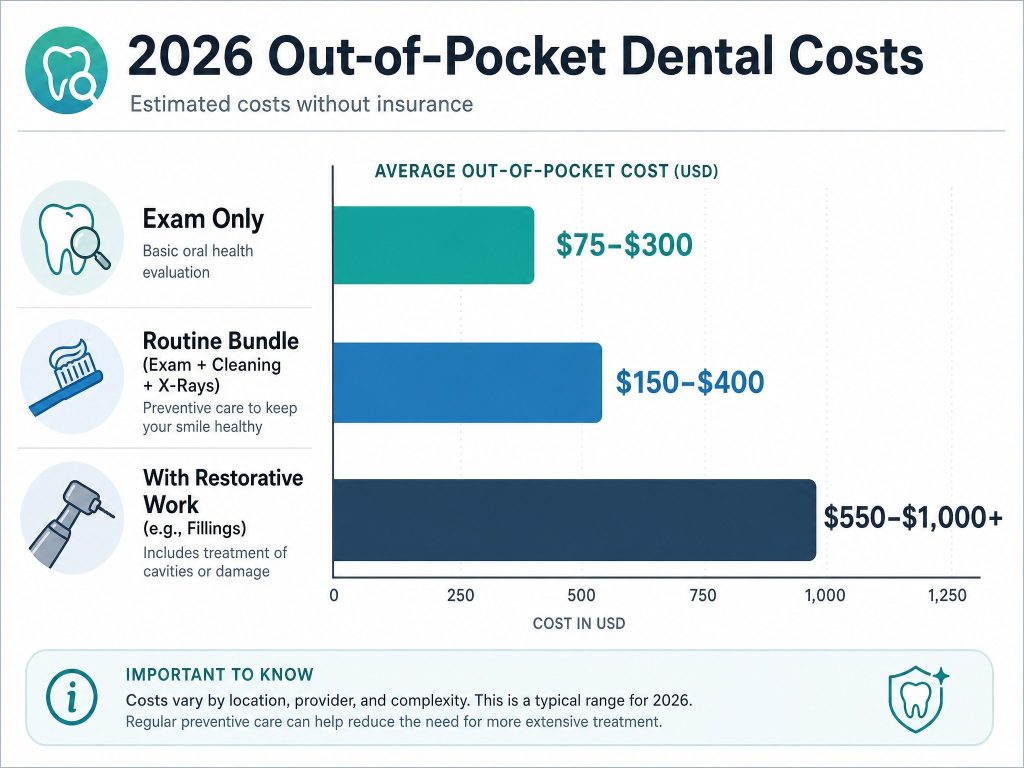
For a “normal” routine visit in the U.S., I’d personally budget $75–$300 out of pocket if you’re not doing much beyond a straightforward appointment, and about $150–$400 for the classic exam + cleaning + X-rays combo. That’s basically consistent with the way consumer pricing roundups show the spread.
So here’s the way it tends to shake out when you’re trying to plan like an adult:
Exam only is usually the cheapest door into the dental office, and it’s the right move if you have a specific concern and don’t want to pay for everything at once. The catch is you might be buying yourself a second appointment.
Exam + cleaning is the “responsible baseline,” as long as you truly qualify for a routine cleaning and you’re not walking in with periodontal issues.
Exam + cleaning + X-rays is the most common “full checkup” experience, especially for new patients or anyone who is due for imaging.
Insurance changes the math, but it doesn’t erase it. PPO dental insurance plans tend to cover preventive services at a high percentage in-network, yet your plan can still block coverage due to timing rules, plan year limits, or out-of-network billing. If you want the high-level context on why out-of-pocket spending keeps showing up even when people have coverage, the ADA’s Health Policy Institute tracks the market in a way that makes the trend hard to ignore in their dental care market research.
Also, state Medicaid fee schedules show you what “low-end” reimbursement can look like when rates are set administratively, like Florida listing adult prophylaxis and periodic exam reimbursement in their 2026 dental fee schedule PDF. That’s not what private offices charge cash-pay patients, but it’s a useful anchor for understanding why prices vary and why some clinics can offer lower fees.
One more thing I think people should budget for, emotionally and financially: annual out-of-pocket is rarely “one cost.” If you stay healthy and keep up with preventive care, you might keep your year around $250–$400 without insurance, but a couple fillings can quickly push you into $550–$1,000+, which matches the way broader consumer budgeting writeups describe the snowball effect, like this breakdown of average dental spending patterns.
Actual costs depend on your oral health, your dentist’s findings, your insurance benefits, what additional services are recommended, and your dental office’s fees.
Timeline: How Long Does a Dental Checkup Usually Take?
Time is part of the price, even if nobody puts it on the receipt.
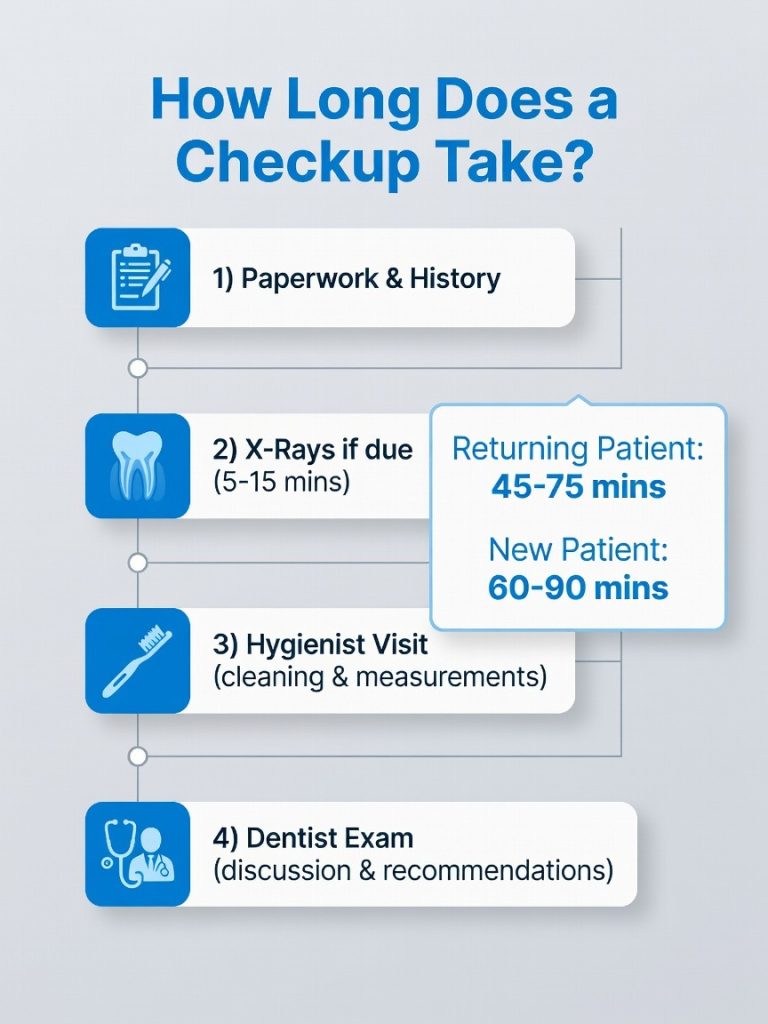
A routine checkup for a returning patient is often 45–75 minutes in real life. New patients commonly run 60–90 minutes because you’re doing intake forms, medical history, imaging, and a more detailed exam.
X-rays themselves are usually quick, more like 5–15 minutes, unless you have gag reflex issues, positioning challenges, or the office is doing a full series.
A simple way to picture the flow:
- Paperwork and health history, especially if you’re new
- X-rays if due
- Hygienist visit for cleaning and periodontal measurements
- Dentist exam and discussion, then treatment recommendations if needed
If you’re booking during a lunch break, that timeline matters more than most people admit.
Pros, Cons, and Tradeoffs of Different Checkup Options
Exam-only appointments feel like the budget move, and sometimes they are. You get answers fast, especially for pain, sensitivity, or “is this a cavity?” anxiety. The downside is you may need a return visit for the cleaning or imaging, and suddenly you’re paying for time, transport, and life disruption twice.
Exam + cleaning is the best all-around choice for most people who are reasonably consistent with routine cleanings. It’s convenient, it’s preventive, it tends to keep your oral health stable, and it reduces the chance you’ll need bigger-ticket work later. The tradeoff is a higher upfront bill than an exam alone.
Insurance vs self-pay is its own weird trade. PPO coverage can lower immediate costs, but it also creates a maze of in-network rules, allowed amounts, and plan limitations. Cash-pay is often simpler, and some offices will offer a straightforward discount program, yet you’re carrying the full expense personally.
If you’re optimizing for “least surprise,” your best move is to ask for a written estimate before anything non-preventive starts.
Common Cost Concerns Patients Have
“I Don’t Have Insurance”
You still have options, but you have to ask like you mean it.
Some offices offer an in-house membership plan or cash discounts. Dental discount programs can reduce the retail fee, and they can be worth it if you’re consistent about routine cleanings. For pricing benchmarks and what deep cleanings can run, the niche but detailed data at DentalCleaningCost.com’s 2026 benchmark is a good reality check.
Low-cost care exists too, though it comes with tradeoffs like longer appointments and limited availability. Dental school clinics can be a strong option if you’re flexible. The most reliable way to find one is the ADEA dental school locator.
“I’m Afraid There Will Be Surprise Costs”
That fear is earned.
A lot of “surprise” charges aren’t random, they’re the result of findings. The office sees inflammation, pocketing, heavy calculus, recurrent decay under an old filling, then the visit changes shape. The fair request is not “promise nothing will change.” The fair request is “tell me before you do it.”
A practical script: ask what’s included in the appointment you booked, what is considered additional services, and whether they can give a range for any likely add-ons.
“I’ve Been Avoiding the Dentist Because of Cost”
Avoiding it usually makes the eventual procedure more expensive and more annoying. Preventive care is the cheap part of dentistry, even when it doesn’t feel cheap.
The CDC and the ADA both track how costly oral disease is at a population level, and the big message is boring but true: catching stuff early saves money, time, and sleep.
“Do I Need X-Rays Every Time?”
No. Most people don’t.
But “not every time” doesn’t mean “never.” X-ray frequency depends on risk, history, symptoms, and how long it’s been since your last images. If you’re prone to cavities, or you have lots of restorations, you may be on a tighter interval than someone with low risk and stable oral health.
How to Decide Which Type of Visit Is Right for You
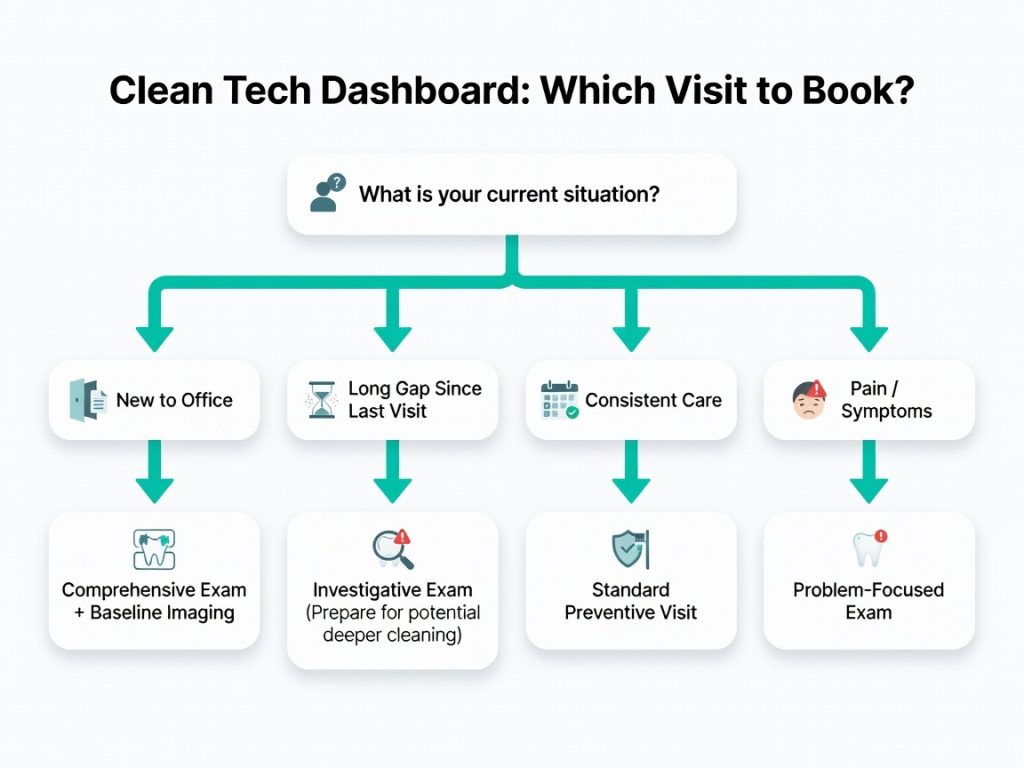
If you’re new to an office, a comprehensive exam plus whatever imaging is appropriate is usually the cleanest starting point, because the dentist needs a baseline to make real recommendations.
If it’s been several years, expect the visit to be more investigative. That doesn’t automatically mean deep cleanings, but it does mean the office is going to measure, look harder, and maybe suggest staged care.
If you just want preventive care and you’ve been consistent with routine cleanings, book the standard preventive visit and ask what imaging is due based on your last X-rays.
If you have symptoms like pain, swelling, a cracked tooth, or a “this feels wrong” spot, book an exam focused on diagnosis first. If you’re not sure whether your situation counts as urgent, this quick guide on whether it’s a dental emergency is a decent gut-check.
Next Step: Get a Personalized Cost Estimate
Online averages are comforting until they’re useless.
A personalized estimate is more accurate because it matches your plan, your network status, your frequency limits, and the actual services being planned. If you have PPO coverage, a benefits verification can tell you whether preventive care is covered at 100%, whether your deductible applies, and what your copay or coinsurance looks like.
If you’re comparing options locally, it also helps to start with a dentist who actually serves the area you’re searching in. If you’re in the South suburbs, you can begin with this dentist in South Holland page and work outward from there.
Dental Care 4 U
16270 Prince Dr.
South Holland, IL 60473
(708) 333-2213
If you want the most direct path to a number you can trust, see the new-patient exam offer and then use the contact page to request a benefits check. If you already know you want a time on the calendar, online scheduling is the simplest route.
FAQs
How much does this cost in South Holland?
South Holland pricing varies by office fees, what’s included in the appointment, and whether you’re in-network with a PPO plan. The fastest way to avoid a pricing guessing game is to ask for the CDT codes they expect to bill and request an estimate based on your specific benefits.
Does dental insurance (PPO) cover it?
Many PPO plans help cover preventive services like exams, routine cleanings, and basic X-rays when you stay in-network, but benefits vary by plan and employer group. Verification matters because frequency limits and deductibles can change your out-of-pocket amount even for “routine” care.
How do I know which option is right for me?
New patient, long gap since your last visit, symptoms, history of cavities, gum issues, lots of old fillings. Those details change the type of exam and imaging that’s appropriate, which changes the cost. If you’re unsure, start with an exam and ask the office to map out the lowest-surprise path forward.
What does a dental cleaning cost without insurance?
If you’re wondering what does a dental cleaning cost, a routine adult dental cleaning commonly runs $75–$200 for cash-paying patients. However, the final price depends on the type of cleaning you actually need. Deep cleanings and debridement cleanings cost more because they require additional time, specialized instrumentation, and sometimes multiple appointments to complete effectively.
Can I get a cost estimate before my visit?
Usually, yes. Many offices can give a preliminary estimate and run a PPO benefits check before you arrive, especially for standard preventive appointments. For out-of-network estimates by ZIP code, FAIR Health also explains how billed charges differ from allowed amounts in their overview of understanding dental costs.