
When comparing crown vs filling vs implant, it’s normal to feel overwhelmed by both the terminology and the potential cost. These treatments serve different purposes, and understanding when each is recommended can make the decision much less intimidating. This guide explains the key differences so you can better understand your dentist’s recommendation and make an informed choice.
So let’s cut through it. The core difference between a filling, a crown, a bridge, and a dental implant comes down to one thing: how much of your natural tooth is still working for you. Fillings address minor decay by preserving healthy enamel. Crowns act as full-coverage reinforcement for severely damaged teeth.
Bridges replace missing teeth by borrowing support from the neighbors on either side. Implants go deeper, literally, replacing both the root and the visible portion of a tooth that’s already gone. Which one you actually need depends on structural integrity, and no amount of online research replaces an exam and X-rays.
| Treatment | Best For | Preserves Natural Tooth? | Replaces Missing Tooth? |
| Filling | Small to moderate decay | Yes | No |
| Crown | Large damage or weakened tooth | Yes | No |
| Bridge | One or more missing teeth | No | Yes |
| Implant | Full tooth replacement | No (replaces lost tooth) | Yes |
That said, knowing roughly what each option does gives you a real edge going into any consultation. You stop nodding along and start asking the right questions.
What a Dental Filling Actually Does
A filling is the most conservative restorative treatment dentistry has. When decay is caught early and the structural loss is relatively small, a filling removes the damaged portion and plugs the gap with composite resin or another material, bonded directly to the tooth. The American Dental Association notes that fillings preserve the most natural tooth structure of any restorative option, which matters because every millimeter of healthy enamel you keep is a millimeter you’re not replacing artificially.
Modern composite resins bond chemically to the tooth surface, which means less drilling compared to older amalgam techniques. Amalgam fillings typically last 10 to 15-plus years; composite resins run closer to 5 to 10 years depending on placement and bite pressure. For smaller cavities, especially on front teeth where appearance matters, composite is almost always the go-to.
Where fillings fall short is size. A large filling on a back molar takes up a significant portion of the tooth’s biting surface, and Consumer Reports points out that while large fillings cost less upfront, they fail at higher rates than crowns under heavy chewing pressure. So “affordable now” sometimes becomes “more expensive later,” which is the kind of tradeoff worth understanding before you commit.
When a Dental Crown Makes More Sense
When do you need a crown? A dental crown is a custom-made cap that covers the entire visible portion of a tooth above the gumline. Rather than serving as a cosmetic treatment alone, its primary purpose is to restore strength and protect a tooth that has been weakened by decay, fractures, large fillings, or other structural damage.
The situations that typically call for a crown include a cracked tooth that’s at risk of splitting further, a tooth so decayed that a filling wouldn’t have enough healthy structure to grip, and critically, any tooth that’s had a root canal. After a root canal, the internal pulp is removed, leaving the tooth brittle. A crown restores function and prevents fracture. Research published through the National Center for Biotechnology Information confirms that crowns show superior long-term durability over direct restorations for root-treated teeth, with excellent 10-year survival rates.
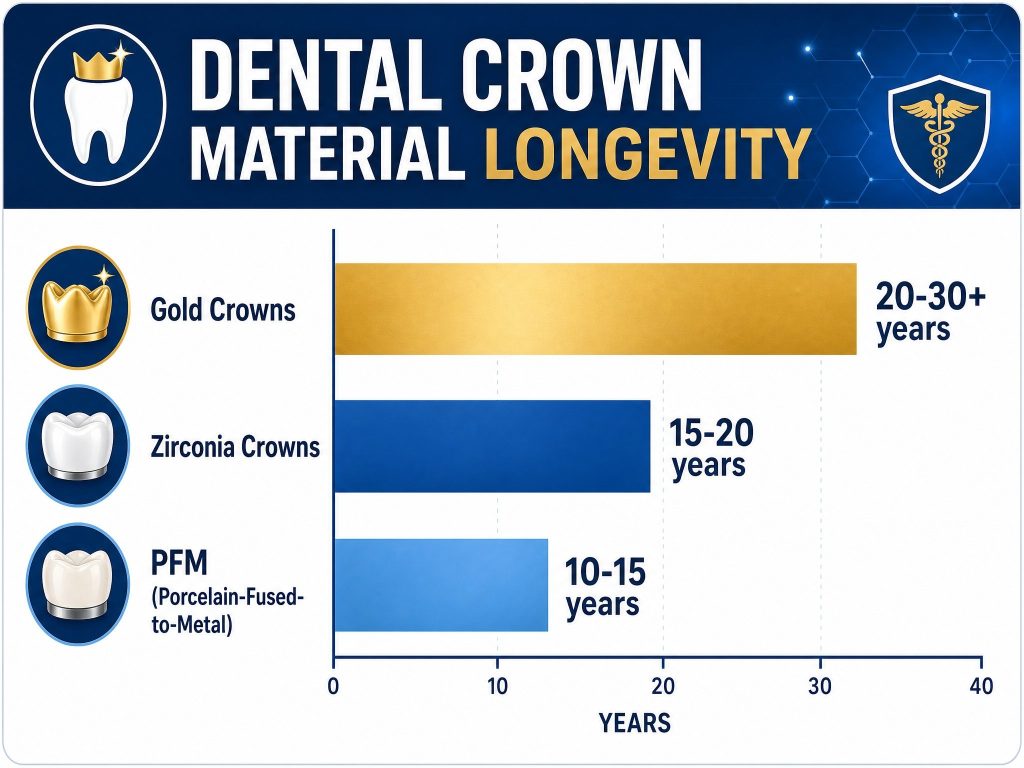
Material choice matters here. Zirconia crowns can last 15 to 20 years. PFM crowns (porcelain-fused-to-metal) typically run 10 to 15 years. Gold crowns, not the most popular aesthetically but arguably the most durable, can last 20 to 30-plus years, making them a legitimate long-game option for back molars that nobody sees anyway. Across materials, studies show roughly 95% of crowns survive beyond 5 years, with 50 to 80% still functional at 15 to 20 years.
The preparation process involves reshaping the original tooth so the crown fits over it, which is a permanent change. A temporary crown goes in while the permanent one is fabricated, and final placement usually happens at a second appointment.
The Case for a Dental Bridge
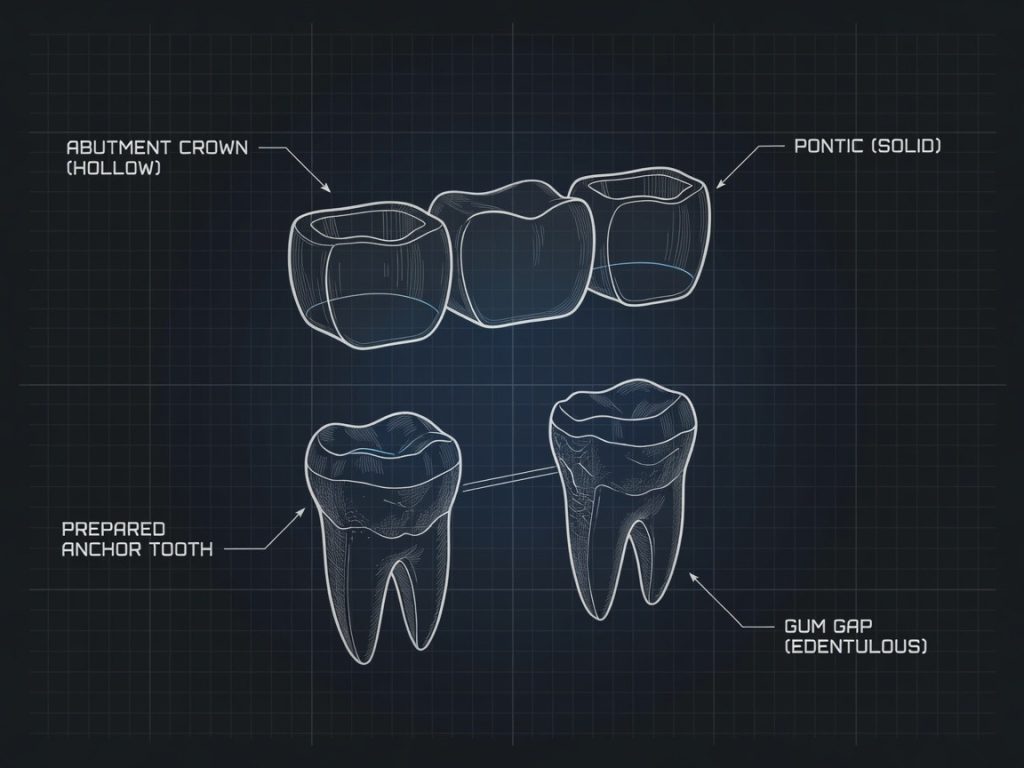
A bridge fills a gap left by a missing tooth. It uses the teeth on either side of that gap, called abutment teeth, as anchors. A false tooth (the pontic) sits in between, suspended across the space. The whole unit is cemented into place.
The trade-off is direct: to anchor a bridge, the adjacent abutment teeth need to be filed down and crowned, even if they were perfectly healthy before. That’s irreversible. For some patients, particularly those with existing damage on neighboring teeth anyway, this is a reasonable path. For patients with healthy adjacent teeth, it feels like a steeper compromise.
Bridges close gaps faster than implants, usually within a few weeks rather than several months. They also tend to cost less upfront, though maintenance is ongoing since the area underneath the pontic requires special flossing tools to prevent plaque buildup and gum disease around the abutments.
What Makes a Dental Implant Different
An implant isn’t a crown replacement. It’s a tooth root replacement, which is a fundamentally different thing. A titanium post is surgically placed into the jawbone, allowed to integrate with the bone over a healing period (typically 3 to 6 months), and then topped with an abutment and an artificial crown. The result functions like a natural tooth, from the root up.
The long-term numbers are impressive. Clinical data confirms 95 to 98% success rates within the first 5 years, dropping only slightly to 92 to 97% at 10 years and approximately 92% at 20 years. Over 3 million Americans currently have implants, with roughly 500,000 new placements each year. The bone preservation advantage is real too. When a tooth root disappears, the surrounding jawbone gradually resorbs. An implant post actively stimulates bone maintenance, preventing the structural bone loss that bridges and dentures can’t address.
The caveat: not everyone qualifies. Adequate bone density is necessary for successful placement. Smoking significantly increases the risk of peri-implantitis and failure. And the full process, from consultation through final crown, can span 6 to 12 months depending on whether bone grafting is needed.
When comparing dental bridge vs implant, the right choice depends on your oral health, budget, and long-term goals. A dental bridge replaces a missing tooth by anchoring to the neighboring teeth, making it a faster and often less expensive option. A dental implant replaces both the tooth root and crown, helping preserve jawbone health and offering greater long-term durability, though it typically requires a longer treatment timeline and a higher upfront cost.
Which Treatment Fits Which Problem?
| Dental Problem | Likely Treatment Direction |
| Small cavity | Composite filling |
| Large cavity with minimal remaining structure | Dental crown |
| Cracked or broken tooth (restorable) | Crown |
| Missing tooth with healthy adjacent teeth | Implant |
| Missing tooth with damaged adjacent teeth | Bridge may be considered |
| Multiple missing teeth | Bridge, implants, or combined approach |
This table is a rough map, not a diagnosis. The deciding factor in every case is clinical evaluation, because two cracks that look identical can behave completely differently depending on depth, direction, and location relative to the root.
What This Costs in 2026
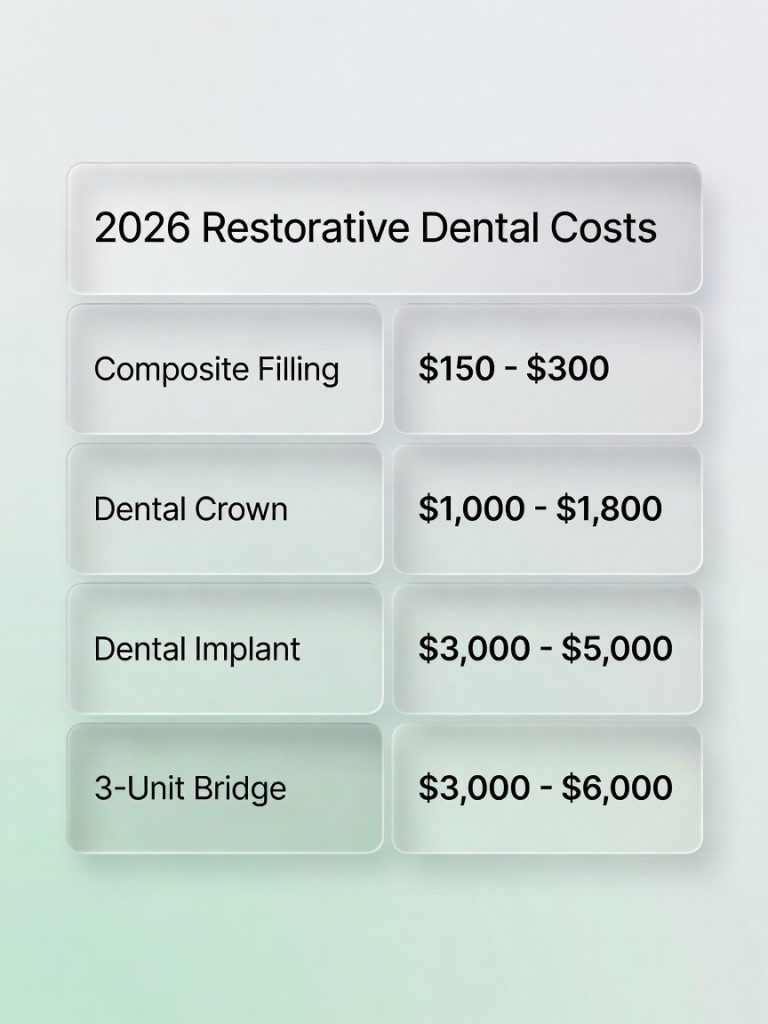
Costs vary considerably based on materials, location, insurance, and case complexity. With that said, here are realistic ranges to work with:
- Composite filling: $150 to $300 per tooth, with PPO insurance often covering 70 to 80% after deductible
- Dental crown: $1,000 to $1,800 per tooth; many PPO plans cover 50%, though annual maximums frequently cap total reimbursement
- Dental bridge (3-unit): $3,000 to $6,000; coverage varies widely by plan
- Dental implant (full placement): $3,000 to $5,000 per tooth including the titanium post, abutment, and crown; bone grafting adds $200 to $3,000 if needed
The math that trips people up is the lifetime value calculation. A filling might cost $200 now but require replacement or escalation to a crown in 8 years. An implant’s higher upfront cost often means no further intervention for 20-plus years. That’s not an argument for one over the other, it’s just context worth having before the conversation with your dentist.
Most dental practices, including practices serving South Holland, IL residents, offer financing options through third-party lenders. PPO insurance benefits should always be verified before committing to a treatment plan, since deductibles, waiting periods, and annual maximums vary significantly across plans.
Common Questions Worth Addressing Directly
Is a crown better than a filling?
Neither is universally better. The amount of remaining healthy tooth structure drives the recommendation. When enough structure exists, a filling is the conservative, appropriate choice. When it doesn’t, a crown is protecting what’s left from further damage.
Is an implant better than a bridge?
Implants preserve adjacent teeth and address bone loss; bridges can be completed faster and may suit situations where adjacent teeth already need crowns. Both are clinically valid in the right context, per Consumer Reports’ assessment of long-term tooth replacement outcomes. Your oral health, bone density, and timeline all factor in.
Can a filling become a crown later?
Yes, and often does. A tooth initially restored with a filling can lose additional structure over time through continued decay, fracture, or wear, eventually reaching a point where a crown becomes necessary. This isn’t a failure of the filling, it’s just tooth biology.
What happens if treatment is delayed?
Untreated decay progresses. A cavity that warranted a simple filling can advance into territory requiring a crown, then a root canal, then potentially extraction. Nothing about that progression is dramatic, it’s just chemistry and time working against an unprotected tooth.
How to Decide What You Actually Need
No flowchart replaces an exam. But the factors your dentist weighs include how much natural tooth structure remains, whether root canal treatment has already been performed, bone density for implant candidacy, current gum health, your bite pattern, budget, and how many teeth are affected. Cosmetic preferences matter too, particularly for front teeth where ceramic crowns or tooth-colored restorations carry more weight than on a back molar.
If you’re in South Holland and working through this decision, Dental Care 4 U at 16270 Prince Dr., South Holland, IL 60473 offers restorative consultations that include comprehensive exams, digital X-rays, treatment option reviews, and insurance benefit verification before any work begins. Dr. Raj Khurana and the team walk through cost estimates and personalized treatment recommendations specific to your case, not a generic script. You can reach them at (708) 333-2213 to schedule.
The goal of any restorative consultation isn’t to sell you the most expensive option. It’s to find the most appropriate one. And that distinction, honestly, is worth a phone call.
FAQs
How much does this cost in South Holland?
Treatment costs vary depending on the procedure, materials, your insurance benefits, and case complexity. A consultation at Dental Care 4 U provides a personalized estimate based on your specific situation.
Does PPO insurance cover fillings, crowns, or implants?
Many PPO plans include benefits for restorative procedures, though coverage levels, annual maximums, and waiting periods differ by plan. Verifying benefits before treatment prevents surprises.
How do I know which option is right for me?
Your dentist evaluates tooth condition, gum health, bone support, and overall oral health before recommending anything. X-rays and a clinical exam are necessary starting points, not optional.
Is a bridge or implant better?
Each serves a different clinical purpose. Implants preserve adjacent teeth and maintain bone density; bridges may offer a shorter treatment timeline. The right choice is patient-specific.
Can a damaged tooth always be saved with a crown?
Not always. If structural loss is too severe or the tooth cannot be reliably restored, extraction followed by an implant or bridge discussion may be more appropriate.